Nature Sounds and Sleep: Unlock Better Rest

A randomized controlled trial at Brigham and Women's Hospital found that sleep onset latency fell by 38%, from about 23 minutes to 13 minutes, when people used sound profiles that share the acoustic shape of rainfall, ocean surf, and river sounds. That single result changes the conversation around nature sounds and sleep. It's not just about feeling relaxed. It's about falling asleep faster in a way researchers could measure.

That matters because the research is helpful, but it's not a free pass to leave any soothing audio on all night and assume it will work the same way for everyone. A systematic review of sleep-oriented auditory stimulation found conflicting results and rated continuous noise as very low-quality evidence overall, which means timing, volume, and sound type really matter. Used well, nature sounds can be a practical tool. Used carelessly, they can become another thing that disturbs sleep instead of supporting it.

Table of Contents

Why Nature Sounds Actually Help You Sleep

An infographic detailing how nature sounds promote better sleep quality compared to white noise based on scientific studies.

The cleanest reason to care about nature sounds and sleep is simple, they can shorten the time it takes to fall asleep. In the Brigham and Women's trial, broadband sound profiles shaped like rainfall, ocean surf, and river noise reduced sleep onset latency by 38%, from about 23 minutes to 13 minutes. That's a concrete shift, not a vague promise of calm, and it gives you a useful starting point if your main problem is lying awake after lights out.

What that result actually means

The number matters because falling asleep is often the hardest part of the night. If your brain is still tracking traffic, hallway noise, or a partner moving around, a steady soundscape can smooth those interruptions into the background. That doesn't mean every nature track works the same way, and it doesn't mean sound is always better than silence.

Practical rule: if your goal is sleep onset, start with a steady sound that masks the room instead of a sound that keeps changing every few seconds.

The bigger lesson is that nature-like sound is not just a comfort object. It can function as a sleep tool, and it works through a real acoustic pattern, not only through personal preference. At the same time, the evidence base isn't perfectly neat. A systematic review of continuous auditory stimulation found very low-quality evidence overall, so the research supports cautious use rather than blanket claims.

That tension is useful. It tells you to treat nature sounds like a sleep experiment, not a fixed ritual. If you use them strategically, they may help. If you assume any calming audio will do the job in any setting, you'll probably be disappointed.

A better way to think about the evidence

The most helpful framing is this, nature sounds can be a measurable aid for some sleepers, especially when outside noise is the primary issue. They're most persuasive when they behave like a masking layer, not when they compete with your attention. That's why rain, surf, and river sounds often feel more effective than random ambience.

The question isn't whether nature sounds are “good” in the abstract. The question is whether the sound you choose matches the problem you're trying to solve.

The Science Behind the Calm

An infographic explaining how nature sounds promote calm through masking effects and restorative associations for better wellbeing.

The science makes more sense once you separate the two main mechanisms. One is masking, which means the sound covers sharp little noise spikes so your brain doesn't keep reacting to them. The other is an autonomic shift, where certain natural soundscapes appear to move the body away from stress physiology and toward a calmer state.

Masking turns noise into a softer background

Think of masking like laying a smooth blanket over a bed full of jagged edges. A car door slams, a neighbor's TV bumps, someone coughs in the next room, and the sudden peak gets softened before your brain fully registers it. That matters because sleep is fragile when your environment keeps producing little surprises.

The Brigham trial fits this logic well. Broadband nature-like sound seems to work because it creates a steadier auditory floor, the kind that makes abrupt changes less noticeable. Rain is especially good at this because it has the broad, even texture that covers peaks without sounding too busy.

Nature sounds can also settle the nervous system

The second mechanism is more physiological. In a forest-vs-city sound study, forest audio was associated with lower oxy-Hb in the right prefrontal cortex, reduced sympathetic nervous activity, lower heart rate, and higher comfort and relaxation ratings than city sounds. That pattern lines up with the body shifting away from fight-or-flight and toward rest-and-digest, which is the state you want before sleep. The forest-vs-city study is a good reminder that the effect isn't only psychological.

Nature sounds can work like a dimmer switch for arousal, not a switch that forces sleep.

That's why a track can feel soothing even when you're not actively focusing on it. Your body may be responding to the acoustic shape and the associations it carries. The sound is doing two jobs at once, it's lowering the chance that sudden noise will grab attention, and it's nudging the nervous system toward a more settled baseline.

There's also a practical detail hidden in the research. Sleep sounds that are meant to calm people usually work best when they stay steady and predictable. If the audio keeps drawing attention to itself, it stops behaving like a sleep aid and starts behaving like content.

Why “calm” isn't enough

Not every gentle sound is equally useful. A track with birdsong, random chimes, or dramatic swells may feel pleasant but still leave too much room for your brain to track variation. The point is not just to sound nice. The point is to reduce arousal enough that sleep can happen more easily.

If you want the simplest summary, here it is. Mask noise first. Lower arousal second. Nature sounds can do both, but only if the sound you choose is stable enough for the job.

Which Nature Sounds Work Best for Different Sleep Goals

A quiet room is one thing, a room that keeps pulling your attention is another. That is why the best nature sound depends on the job you want it to do. Rain, ocean surf, forest ambience, river sounds, wind, and fire each support sleep in a different way, and matching the sound to the goal usually matters more than picking whatever feels pleasant in the moment.

The bracketed study note from the coronary-care setting is useful here, because it showed that both nature sounds and silence improved sleep quality. Audio helps some nights, silence helps other nights. The point is to choose the option that lowers strain without adding a new distraction.

Compare soundscapes by goal

Soundscape Best For Masking Strength Rhythm Quality
Rain Falling asleep, blocking sharp noise High Steady and even
Ocean surf Sleep onset anxiety, gentle breathing cues High Slow and wave-like
Forest Relaxation, winding down after stress Moderate Soft, varied, natural
River Sleep onset and light background masking Moderate to high Continuous, flowing
Wind Atmosphere, quiet rooms, gentle drift Moderate More variable
Fire Cozy bedtime mood, short wind-down Lower to moderate Irregular and flickering

Rain is useful when the main problem is interruption. Its broadband quality spreads across the room and helps cover sudden noises without asking your brain to track detail. Ocean surf works well when you want a little rhythm, since the rolling pattern can be soothing without becoming busy. Forest sounds usually sit in the middle. They feel softer and more organic, which suits people who want a calmer backdrop rather than a strong masking layer.

River sounds also land in that middle zone. They are steady enough to smooth out the room, but textured enough to feel natural and easy to listen to. Wind and fire can still be comforting, though their changing edges make them better for winding down than for blocking noise through the night.

If you want a simple rule, use rain or surf for noisy rooms, forest or river for gentler relaxation, and wind or fire when the goal is mood rather than masking.

For readers who track dreams, there is one more layer to consider. The sound you use as a sleep cue can become part of your recall routine if you pair it with a gentle wake-up and a quick dream note in an app like Dreamscape. If your dream content often involves water, you may also enjoy the symbolic angle in dreaming of water, since the emotional tone of the sound can shape how you reflect on the dream afterward. For a broader look at dream symbolism, explore our dream meanings library.

The simplest choice rule is this, pick the sound that matches the problem. Use rain or surf for noisy rooms. Use forest or river for softer relaxation. Keep silence on the table if it works better than audio on a given night.

How to Set Volume, Timing, and Personalization

The three levers that decide whether nature sounds help are volume, duration, and fit. Get those wrong, and the track can turn from helpful to distracting. Get them right, and you've got a repeatable sleep cue you can use without guessing.

An instructional graphic on how to set volume, timing, and sound personalization for sleep aid tools.

Use the volume as a masking layer, not a performance

A practical target is around 40 to 50 dB, roughly the volume of a quiet conversation. That range is high enough to smooth out sudden room noise, but low enough that the sound itself doesn't become stimulating. If you're checking it by ear, the better question is not “Can I hear it clearly?” but “Does it fade into the room?”

Keep the timer intentional

A good starting point is a 45 to 60 minute sleep timer for sleep onset. That gives the sound enough time to cover the early, vulnerable part of the night without turning into all-night background by default. If you wake in the middle of the night and know sound helps you resettle, you can extend it selectively instead of leaving it on blindly.

Test one sound for a full week

A simple seven-day trial keeps you from overreacting to one bad night. Choose one soundscape, set one volume, and log two things each morning, how long it took to fall asleep and how many times you woke. If the result isn't improving after a week, switch to a different sound category rather than just turning the volume up.

A few small details help too. A fade-out feels gentler than a hard stop, because the sudden silence can wake light sleepers. Stereo is fine if it sounds natural to you, but mono can be more consistent if your headphones or speaker setup makes the sound uneven. A dedicated sleep track usually works better than a random ambient playlist because it's designed to stay stable instead of jumping between moods.

Quick check: if the sound keeps catching your attention, it's too interesting to be a sleep sound.

For readers who want an app-based workflow, a tool like Dreamscape can sit inside that trial as one option for sleep sounds, journaling, and recall tracking. The important part is the method, not the brand. Use the track, note the result, and let your own data tell you whether the choice is helping.

When Nature Sounds Can Hurt Your Sleep

The biggest mistake people make is assuming that more audio must mean better sleep. That's not always true. A 2026 study discussed in independent coverage raised concern that broadband noise during sleep could be harmful for developing brains because it may reduce REM sleep, which matters for memory consolidation and emotional regulation. That doesn't mean every sound is dangerous. It does mean all-night playback deserves a closer look, especially for children and infants.

The tradeoff isn't just comfort, it's exposure

A sound that helps you fall asleep for 45 minutes can become a problem if it keeps running at a loud level for eight hours. The issue is exposure, not just preference. For adults, the safer habit is usually to use sound strategically for sleep onset, then see whether you need it later in the night.

For households with babies or children, caution matters even more. Their ears are more sensitive, and they have less ability to tell you when the sound is too much. If you're unsure, lower the level, increase distance from the speaker, and favor the shortest effective use.

The hearing-health angle also matters for adults who already live around noise. If you're trying to protect your ears, Boca Raton hearing loss prevention is a useful resource from Z Audiology because it puts safe listening into the broader context of avoiding unnecessary exposure. The same principle applies at night. A sleep sound should support rest, not raise your acoustic load.

Use a decision rule, not a default

If you're stuck between sound, earplugs, or silence, decide by age and purpose.

  • Adults: start with low-volume, time-limited sound if outside noise is the problem.
  • Children: keep the sound gentler and shorter, and avoid anything that feels immersive.
  • Infants: silence or very cautious, quiet background sound is usually the more conservative choice.
  • If nothing helps: use the quietest option that doesn't create new stress.

If you've ever woken up feeling stuck or disoriented, it can help to notice how sensory load affects the body. That's one reason some people explore the feeling described in sleep paralysis feeling stuck, because the body's reaction to nighttime stimuli can shape how safe or unsafe the room feels.

The point isn't to fear nature sounds. The point is to use them with the same care you'd use for any other sleep aid. If the volume is low, the duration is intentional, and the room is already quiet enough, the risk drops. If you crank the sound up and leave it running all night, you're no longer using a sleep helper, you're creating a new source of stimulation.

Using Nature Sounds to Remember Your Dreams

Nature sounds can do more than help you fall asleep. They can also become part of a dream recall habit if you use them as a cue for a gentler morning. The trick is to treat the audio as a bridge, not as background noise you forget about. A calm transition helps you stay close to the dream long enough to remember it.

Screenshot from https://usedreamscape.com

Use sound as a wake-up cue, not only a sleep cue

Start with the same soundscape you use at bedtime, then let the final minutes of it become your wake-up cue. A gentle transition is easier on recall than a jarring alarm because your mind isn't being yanked out of the dream state. The first 30 seconds matter most, so keep a notebook or app close enough that you can write before your memory starts slipping.

That's where a dream journaling routine becomes useful. Dreamscape combines sleep sounds with a built-in journal, AI interpretations, emotional pattern detection, and visual artwork, so the transition from waking to recording doesn't feel fragmented. You don't need a perfect interpretation on the spot. You just need a trace of the dream before it fades.

A simple nightly recall routine

  1. Choose one sleep soundscape. Use it only for bedtime so your brain starts linking it with sleep.
  2. Set a gentle ending. Let the sound fade into waking instead of using a harsh alarm.
  3. Write immediately. Capture symbols, emotions, colors, and any single fragment you can still feel.

The reason this works is straightforward. Dreams are easier to remember when the wake-up process is calm enough for the brain to hold onto the material for a few moments longer. A soft audio ending gives you that buffer, and a journal gives the memory somewhere to land.

If you keep doing that for a week, you'll usually start noticing patterns. Some people remember more emotional detail. Others remember the setting first. Once those details are on the page, interpretation becomes much easier, because you're working from your own material instead of trying to reconstruct it later.

Your Nightly Nature Sounds Framework

The best way to use nature sounds is to make three decisions before bed. First, ask what your goal is tonight, falling asleep faster, staying asleep, or recalling dreams. Second, pick the soundscape that fits that goal, usually rain or surf for masking, forest or river for softer calm, or silence if that works better. Third, set your safe volume and duration so the sound supports rest instead of becoming another input.

That framework keeps the research honest. The Brigham result shows that sound can reduce the time it takes to fall asleep. The forest-vs-city findings suggest that some natural sounds also calm the body itself. The safety question reminds you not to confuse “more sound” with “better sleep.” All three belong in the same decision.

If you want a broader bedtime reset, tips for restful nights from Willis Furniture & Mattress can help you think about the room itself, not just the audio. Light, comfort, and routine still matter. Nature sounds work best when they're part of that wider sleep environment.

For dream explorers, the follow-through is just as important as the bedtime setup. A sound that helps you sleep can also help you remember what happened there, especially if you wake gently and write quickly. That turns one night of sleep into material for reflection, symbolism work, and recurring-theme tracking.


If you want a simple way to turn sleep sounds into a dream practice, try Dreamscape tonight. It pairs sleep sounds with a journal, AI dream interpretation, and image generation, so you can move from quieting the room to capturing the dream in one flow. Visit Dreamscape and test one soundscape, one timer, and one journal entry for the next seven nights.

Passing Out in a Dream: Meanings & Interpretations

You wake up with your heart still racing. In the dream, you were standing, talking, walking, or trying to keep up, and then everything went dim, your body folded, and the next thing you knew, you were jolted awake with that uneasy aftershock that makes you wonder what just happened. A lot of people dismiss that kind of dream as “just stress,” but passing out in a dream sits at the intersection of emotion, sleep physiology, and, sometimes, real medical relevance.

That's why this experience deserves more than a one-line dream dictionary answer. In some cases, it reflects overwhelm, avoidance, or burnout. In others, the brain is simulating a loss of consciousness during altered sleep states, or the dream is echoing a real body event that deserves attention. The difference matters, and the details matter even more.

If you've had this dream more than once, the patterns around it can tell you a lot. The sections below walk through the neuroscience, the symbolic layer, the most common triggers, how to read the dream in personal context, how to improve recall, and the red flags that mean it's time to look beyond symbolism.

Table of Contents

Waking Up From a Fainting Dream

You're in the middle of a dream, and everything suddenly goes wrong in the most unnerving way. Maybe you're in a crowded room, maybe you're walking somewhere important, maybe you're trying to speak, and then your knees give out or the world turns black. You wake up with a jolt, your body tense, as if it had just survived something real.

That reaction makes sense. The body often wakes before the mind finishes explaining the dream, so the feeling lingers as confusion, fear, or a weird sense that you've just crossed a boundary you didn't choose. For many people, that's the moment they start searching for a meaning and land on vague interpretations like helplessness or anxiety. Those ideas can be part of it, but they're only part.

A more useful frame is to hold two possibilities at once. Passing out in a dream can point to emotional overload, but it can also overlap with sleep-state phenomena or, less commonly, a bodily event that got folded into dream imagery. That's why the dream deserves careful attention rather than a quick symbolic label.

One of the easiest places to get confused is when dream language overlaps with bodily language. A dream of “fainting” might be symbolic, but it can also reflect the brain's rendering of altered awareness, especially when sleep is fragmented or unstable. If you've also had dreams where you couldn't open your eyes, that can belong to a related family of altered-state dream experiences, which is why the dream theme on unable to open eyes can be useful context.

The rest of this article moves from the science of syncopal simulation to the emotional triggers, then into personal interpretation, recall practices, and the signs that deserve real-world follow-up.

What Your Brain Is Simulating When You Faint in a Dream

A fainting dream usually is not the brain inventing a random scene. It is more often a simulation of syncope, the medical term for a brief loss of consciousness caused by reduced blood flow to the brain. In waking life, that drop in cerebral blood flow can interrupt awareness very quickly. In a dream, the brain can recreate the feeling of collapse, darkness, or helplessness without any cardiovascular failure at all. The body is not necessarily fainting, the brain is staging the experience.

That distinction matters because the dream can copy the subjective shape of a real syncopal episode while the sleeper stays physically safe in bed. A 2011 clinical study found that people in a syncope group reported a subjective dreaming experience more often than the comparison group, and the authors treated that experience as a useful diagnostic clue rather than a random anecdote, with medical value for distinguishing syncope from seizures (PubMed). In plain terms, the brain can generate dreamlike imagery during a real fainting episode, and it can also simulate fainting during sleep.

Why the dream feels so convincing

The dreaming brain blends sensation, memory, and emotion into one event. That is why the dream may include dizziness, a collapsing body, a darkening field of vision, or the sense that you have lost control of your surroundings. The content does not need to be literal to feel physically real.

Practical rule: when a dream contains both bodily collapse and intense fear, do not assume the message is purely symbolic. Sometimes the brain is translating a state shift into story form.

A newer neuroscience study described vivid, dream-like episodes during induced fainting, and those experiences were associated with slow-frequency brain waves in the delta and theta bands. The reported content included out-of-body sensations, accelerated thoughts, and visions of other places, which shows that unconsciousness during fainting does not always mean the absence of conscious-like experience (neuroscience summary).

That makes passing out in a dream a bridge phenomenon. It sits between sleep psychology and neurology. The dream may carry emotional meaning, and it may also rehearse the experience of altered consciousness itself.

When a dream includes a stuck, frozen, or unable-to-move feeling, it can overlap with related sleep-state experiences. A closer look at sleep paralysis and the feeling of being stuck can help separate that pattern from a fainting image.

The emotional side still matters here. If the dream shows collapse during a period of anxiety, burnout, or overwhelm, the image may be echoing what your nervous system already feels. That is one reason Interactive Counselling's anxiety services can be relevant for readers who notice that these dreams cluster around persistent stress.

A purple infographic explaining the brain's mechanism behind simulation, safety, and neural replay during fainting.

Psychological and Physiological Triggers Behind Fainting Dreams

The symbolic reading usually starts with one core idea, loss of control. Many people report this dream when life feels overloaded, when they're carrying too much, or when they're avoiding something that feels emotionally expensive. That doesn't mean the dream is “just stress,” though. It means the dream may be organizing stress into a dramatic bodily image that's easier to notice than a vague sense of strain.

The physiological side matters just as much. Clinical guidance notes that true fainting is syncope, while presyncope can involve lightheadedness, weakness, sweating, nausea, and palpitations before an actual fainting episode (Healthline's syncope overview). In sleep medicine, hypnagogic hallucinations can occur around sleep onset, and they're more likely when people are sleep-deprived or using alcohol or other substances. That means some fainting dreams may arise from sleep-state instability rather than symbolic content alone.

Short-term stress, chronic burnout, and sleep disruption

There's a real difference between having a rough week and living in a sustained state of depletion. A single bad day can trigger a fear dream. Repeated overload is different, because it can erode sleep quality, increase emotional reactivity, and leave the brain more prone to intense dream imagery. In that setting, the dream can act like a pressure valve, but it can also become a repeating signal that the system isn't recovering well.

If anxiety is part of your pattern, support that addresses the emotional load can help. Someone looking for structured help might consider a service like Interactive Counselling's anxiety services when the waking stress behind the dreams feels persistent or hard to manage alone.

Fainting dreams often ask two questions at once. What am I carrying emotionally, and what is my sleep environment doing to my nervous system?

The sleep side can be overlooked because the symbolism feels more interesting. That's where confusion grows. A dream that feels like collapse may be linked to bedtime alcohol use, inconsistent sleep timing, or a body that's sliding into sleep unevenly. It's also why recurring episodes deserve pattern tracking instead of one-off interpretation.

For readers who also have dreams of feeling stuck or unable to move, the overlap can be clarifying. A related dream pattern is discussed in sleep paralysis and feeling stuck, where the body's sleep-state immobility can shape the dream in a different but related way.

A diagram illustrating the psychological and physiological triggers that can lead to dreaming about fainting.

How to Interpret Your Fainting Dream in Personal Context

Start with the scene, not the symbol. Ask what was happening right before the fainting, who was present, and what the dream felt like in your body. The point is to locate the pressure point. A fainting dream that happens while you're being watched can carry a very different emotional charge from one that happens alone in a hallway or at home.

Journaling prompts that make the pattern visible

Write down the answers as soon as you wake up, before the details blur.

  • What happened in the dream right before I lost consciousness? This helps identify the trigger moment, not just the collapse.
  • Who was there? The presence of a boss, family member, stranger, or nobody at all can change the emotional meaning.
  • What emotion came first? Fear, shame, exhaustion, anger, or numbness often points to the waking-life issue.
  • Where in life do I feel overloaded right now? Work, caregiving, money, health, or relationships can all show up symbolically.
  • What am I avoiding? The dream may be highlighting a task, conversation, or decision you've been trying not to face.

If the dream resembles falling or losing footing before the blackout, it can help to compare it with dreaming of falling, since the two patterns often share the same emotional root but differ in how helplessness is expressed.

A useful habit is to look for repetition across multiple dreams instead of over-reading one isolated event. One dream may reflect a tough night. A cluster of similar dreams says more about your current state. Repetition can point to a life area that keeps asking for attention, especially when the emotional tone stays the same even as the scenery changes.

Reflection cue: if the dream keeps ending in collapse, ask where in waking life you're pushing past your limit without noticing it.

That's the interpretive goal. Not to pin a single meaning on the dream, but to notice which part of your life feels like it's nearing a shutdown point.

Techniques for Better Dream Recall and Lucid Awareness

Dream recall improves when you make it easier for the waking brain to catch the dream before it evaporates. Keep a notebook or phone note by the bed, and write down whatever remains, even if it's only “collapsed, dark room, fear.” A small fragment is enough to start building a pattern.

Set a simple intention before sleep. Tell yourself, “If I have a fainting dream, I'll remember one detail.” That tiny prompt often helps the mind tag the experience for recall. A regular sleep rhythm also helps, because the brain tends to remember dreams more clearly when sleep is less chaotic.

Dreamscape's three-step flow of record, interpret, and visualize fits this kind of practice well, because it gives your memory a place to land before the details scatter. The screenshot below shows the app's journal-style entry flow in action.

Screenshot from https://usedreamscape.com

Lucid awareness without forcing it

Lucid dreaming doesn't require you to control the whole dream. It starts with awareness. If you notice the fainting moment while still inside the dream, you can pause and ask, “What am I reacting to?” That kind of gentle lucidity can turn a frightening scene into a clue.

A few practical habits support that shift:

  • Record immediately: capture the dream before checking messages or getting out of bed.
  • Name the feeling: one word, like panic or heaviness, can anchor the memory.
  • Track sleep conditions: note late alcohol, poor sleep, or unusual stress, because patterns often emerge.

If you want a calmer dream environment overall, relaxation practices and steadier sleep timing usually help more than dramatic efforts to force a lucid dream. The goal isn't to control every image. It's to become present enough to notice what the dream is doing.

When Fainting Dreams Signal Something Beyond Symbolism

A fainting dream usually points to stress, body tension, or a shift in sleep state. The harder question is when the dream stops being only symbolic and starts looking like a signal worth checking more closely.

If you wake with chest discomfort, a pounding heart, strong headaches, sweating, or repeated lightheadedness while awake, treat the dream as part of a larger picture. Those symptoms do not prove a serious problem by themselves. They do mean your body may be asking for attention, the same way a dashboard light can point to several different issues before the cause is clear.

A simple red-flag framework

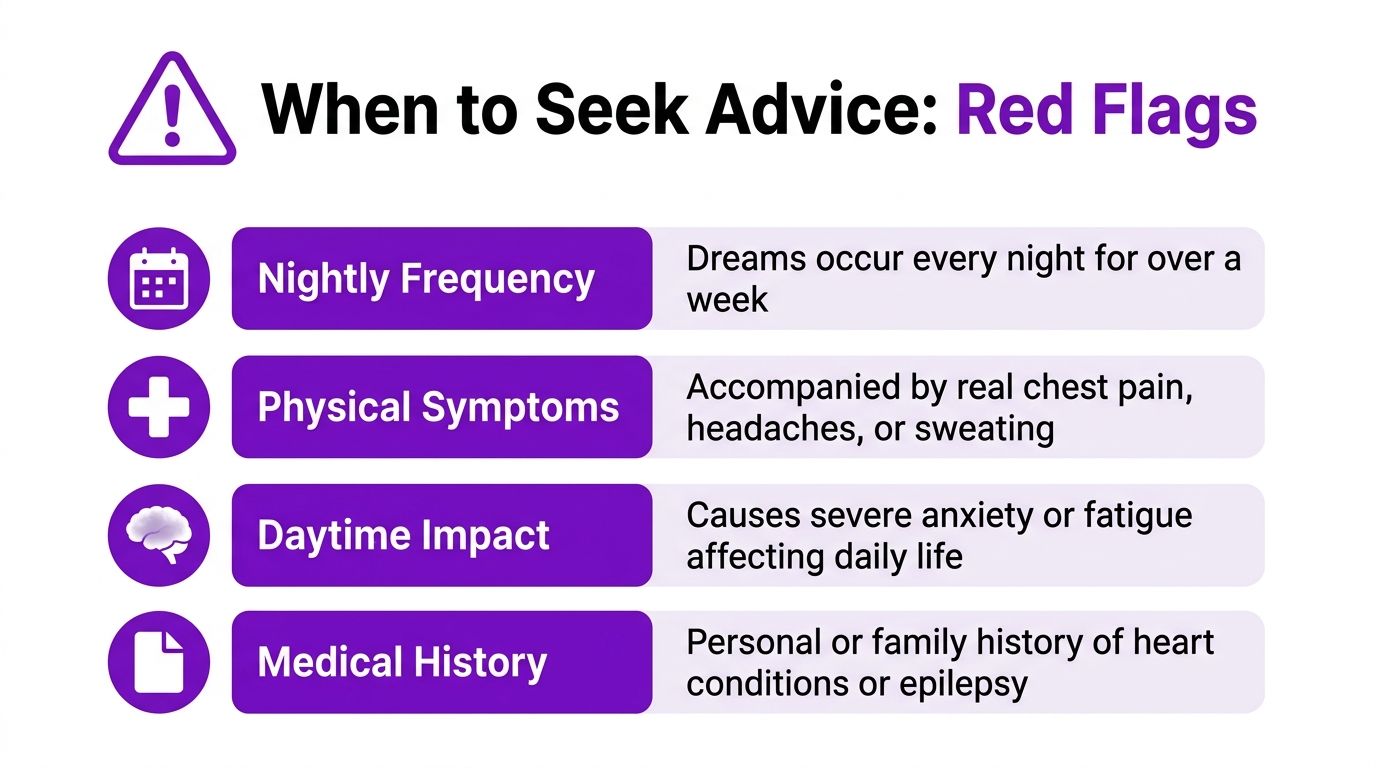
  • Nightly Frequency: if the dreams show up almost every night for a while, and especially if they break up your sleep, take the pattern seriously.
  • Physical Symptoms: if real-world symptoms appear too, the dream is no longer just an inner story.
  • Daytime Impact: if you feel drained, anxious, or mentally foggy during the day, the effect is spilling beyond sleep.
  • Medical History: if you have a personal or family history of heart conditions or epilepsy, it makes sense to lower the threshold for checking in.

The overlap with true syncope matters here. As noted earlier, research has found that dream content can sometimes offer useful clues in fainting episodes, so a dream journal may contain medical information as well as symbolic material (PubMed). If fainting or near-fainting has happened while you were awake, a sleep specialist, cardiologist, or primary care clinician can help sort out the cause.

A red flag chart listing four key symptoms indicating when to seek medical advice for recurring dreams.

If the pattern is mainly emotional, it often settles when stress eases and sleep becomes steadier. If it keeps returning even after those changes, or if the waking symptoms stay in the background, talk with a professional who can look at both body and mind.

Transforming Dream Insights Into Waking-Life Action

A fainting dream can be a warning light, not a verdict. Sometimes it says you're overloaded, sometimes it reflects sleep-state instability, and sometimes it points toward a real medical issue that deserves follow-up. The useful move is not to panic, but to respond.

Treat the dream as a three-part check-in. First, ask what emotion was too big to hold. Second, look at sleep conditions, timing, substances, and rest. Third, notice whether there are bodily symptoms or a history that changes the risk picture. That combination gives you a more grounded reading than symbolism alone.

The strongest dream work happens when curiosity replaces fear. You don't have to treat every fainting dream as a mystery to solve, but you can treat it as data worth keeping. Over time, that kind of attention turns scattered dream moments into a clearer map of your inner and physical state.


Dreamscape gives you a simple place to capture these moments before they fade, then helps you interpret recurring symbols and visual patterns with more clarity. If you want to explore fainting dreams with structure instead of guesswork, visit Dreamscape and start turning your dream notes into insight you can use.

Dream Interpretation Being Murdered: What It Really Means

You wake up with your chest tight, sheets twisted around your legs, and a fragment of the dream still clinging to you. Maybe you saw a stranger's face. Maybe it was someone you know. Maybe the feeling is worse than the image, because the dream didn't just scare you, it felt disturbingly real.

That reaction makes sense. Dreams of being murdered are not rare, and they're often less about literal danger than about fear, pressure, conflict, or change. If you're looking for a way to understand the dream without dismissing it or spiraling into panic, start with the simple fact that the mind speaks in symbols when it's sorting through stress.

Table of Contents

Waking Up From a Murder Dream

You sit up fast, maybe gasping, maybe half-awake and already trying to remember who hurt you in the dream. The body doesn't always know the difference between a dream threat and a waking one right away, so your heart may still be racing when your mind is already asking, What was that about?

That's the moment to slow down. A murder dream can leave behind a heavy emotional residue, even when the details blur within minutes. The dream may feel like a warning, but more often it's a dramatic way the mind processes fear, loss, or powerlessness.

One reason this kind of dream stays vivid is that violent imagery grabs attention. A dream in which you're being killed can feel more intense than a quieter nightmare because the stakes are so high inside the dream itself. That intensity doesn't automatically mean prediction, and it doesn't mean something is wrong with you.

If you've ever had to work through a visually intense scene in your waking life, you may know how quickly the mind reaches for symbolic framing. People sometimes use tools like a workflow for a 3D figurine from photo to turn a striking image into something they can study from another angle, and dream work is similar in spirit. You're not endorsing the scene. You're looking at it closely enough to learn what it's carrying.

Practical rule: treat the first minute after waking as stabilization, not interpretation. Breathe, orient to the room, then return to the dream once your body has settled.

The point is simple. A murder dream is unsettling, but it's also understandable. Once the fear softens, you can start asking better questions than “Why did I dream that?” You can ask, “What was the dream trying to organize for me?”

How Psychologists Read Dreams of Being Murdered

Psychology usually treats murder imagery as metaphor, not prophecy. The strongest readings center on threat, conflict, and transformation, which means the dream is more likely to reflect what feels dangerous, ending, or overwhelming in waking life than to describe a literal event. That fits the broader clinical view that dream content often encodes emotion before logic.

A psychological mind map explaining how psychologists interpret dreams about being murdered through various reflective steps.

The dream as a threat drill

One useful analogy is the brain's overnight security drill. During sleep, the mind can rehearse danger, powerlessness, escape, and survival in exaggerated form, which is why violent dreams often feel so urgent. In that frame, being murdered is less like a prediction and more like an alarm system testing what scares you most.

That's also why people often wake with a strong sense of dread even when nothing in the dream points to a real-world attacker. The emotional core is the point. The dream may be highlighting the pressure you've been carrying, not a future event.

The dream as a forced ending

Another common psychological reading is transition. A murder dream can symbolically represent the end of a role, habit, relationship, or identity that no longer fits. The mind sometimes uses extreme imagery to say, “This part of life feels like it's being terminated, whether you wanted that or not.”

Dreams can feel paradoxical. Something in you may want change, while another part resists it. The violence in the dream can reflect that inner split, especially when waking life already feels like a threshold.

The dream as pressure release

A third reading is suppressed emotion. Anger, fear, grief, and helplessness don't always show up neatly during the day, so sleep gives them a stage. In that sense, murder imagery can function like a pressure valve, letting the mind dramatize emotions that don't yet have words.

The helpful vocabulary here is basic but powerful. Inner conflict means part of you is in tension with another part. Loss of agency means you feel pushed around, cornered, or unable to act. Transition means something old is ending, even if the new thing hasn't fully arrived yet.

Who the Murderer Is and Why It Changes Everything

The meaning changes a great deal depending on who was doing the killing, who you were in the dream, and how you felt while it was happening. A dream about being murdered is not a single symbol with one fixed message. A stranger, a parent, an ex, or a faceless figure each shifts the emotional logic in a different direction.

The same applies to your own role. If you were the victim, the killer, or only a witness, the dream is asking a different question each time. Analysts often connect the victim role with pressure or helplessness, while the killer role can point to cutting off a habit, ending a bond, or pushing away an unwanted impulse. A witness position usually suggests distance, fear, or unresolved observation instead of direct confrontation.

Victim, witness, or killer

If you were the victim, the dream often points to external pressure. That does not mean someone is attacking you. It usually means something in waking life feels overpowering, such as work strain, family conflict, a breakup, or an environment that leaves you feeling cornered. The emotional tone matters most here, especially if the dream included panic, paralysis, or pleading.

If you were the killer, the dream often reads differently. It may show a wish to end something decisively, even harshly, such as a draining routine, a relationship pattern, or a version of yourself that no longer feels sustainable. That does not make you violent. It suggests the psyche may be using a severe image to express a clean break.

If you were only watching, the dream can feel stranger, but it still carries meaning. Witness dreams often hint at emotional distance, unresolved judgment, or a sense that you are seeing a conflict unfold without fully intervening. The role matters because it changes whether the dream is about being overwhelmed, carrying out the ending, or standing apart from the rupture.

Stranger, acquaintance, or faceless attacker

A stranger often maps to general stress or anxiety that has not found a face yet. The attacker is unknown because the pressure is diffuse. A known person usually points toward a specific relationship issue, betrayal, resentment, or unfinished emotion tied to that person.

A faceless attacker can feel more frightening because it removes a clear target. That usually suggests broad burnout, chronic tension, or a threat that feels systemic rather than personal. Recurrence matters too. A one-off dream may reflect a rough night, while repeating dreams deserve more attention because the pattern may be asking for notice.

For a broader symbolic frame, the language in this dream meaning guide fits the idea that dream death often signals transformation rather than literal harm. That does not replace your own interpretation, but it can help when the dream feels too intense to fit into one simple meaning.

The best interpretation is the one that fits the role, the target, and the feeling at the same time.

Cultural and Spiritual Layers of the Murder Dream Symbol

A murder dream can feel alarming in a very specific way. You wake up with the image still close, and the first instinct is often to ask whether it means danger, guilt, or a message from somewhere beyond ordinary life. Psychological reading explains part of that reaction, but many spiritual and cultural traditions treat dream death as a sign of passage, initiation, karmic movement, or contact with forces larger than the individual self. That does not make one reading automatically correct, yet it does show why the dream may feel heavier than a typical nightmare.

Different traditions give the image different roles. In folklore, violent dream scenes may point to the symbolic death of an old self, a warning from ancestors, or an omen that life is changing shape. The same dream can feel like a threat in one worldview and like a threshold in another. The meaning usually depends on how the dreamer understands death, memory, and spiritual language in the first place.

Some people immediately connect the dream to ancestry. Others read it as a rite of passage, especially if waking life already feels like it is breaking apart and reforming. Still others see guilt, karma, or a moral reckoning in the image. Those readings can sit beside each other without canceling one another out, because dream symbols often carry more than one layer at once.

A useful way to sort through that is to notice what the dream leaves behind. If you wake feeling watched, changed, or summoned, a spiritual frame may fit better than a purely clinical one. If you wake tense, depleted, and afraid, the dream may be reflecting stress, grief, or overload more than a message with sacred meaning.

For readers who want a wider symbolic vocabulary, this dream meaning guide gives a helpful point of comparison without forcing the image into a single neat answer. That kind of reading works better here because murder dreams rarely stay inside one cultural box, and the attacker, the dreamer's role, and how recently the dream happened all shape the meaning.

The safest conclusion is also the most practical one. Meaning is layered. A murder dream can carry psychological pressure, spiritual symbolism, and ordinary life stress at the same time, like different transparent sheets laid over the same image. You do not have to pick only one lens unless that choice helps you feel steadier when you wake up.

Common Triggers and What Your Dreams Might Be Telling You

Violent dreams often show up when the nervous system is already loaded. Independent sleep guidance links recurring nightmares with stress, trauma, medications, and sleep disruption, and the practical point is that the dream may be a signal of load rather than a standalone symbol. If your life has been full of pressure, the dream may be giving that pressure a face and a scene.

That matters because people often search for one hidden meaning when the cause is simpler. A job loss, divorce, move, family rupture, or ongoing exhaustion can all intensify disturbing dreams. So can trauma history, some medications, and poor sleep continuity.

What to ask yourself first

  • “What changed recently?” Big transitions often show up in dreams before they feel settled in waking life.
  • “What emotion did I feel most strongly?” Fear, rage, relief, or numbness can point to different waking stressors.
  • “What happened in my body when I woke up?” Tight chest, racing pulse, or sweating can suggest the dream was tied to high arousal.
  • “Has this happened before?” Recurrence can turn a symbolic dream into a pattern worth tracking more carefully.

A chart explaining common emotional and physical triggers for dreams and how they reflect your subconscious mind.

One useful habit is a short journal entry immediately after waking. Write the date, a one-line summary of the dream, the dominant emotion, any current stressors, and the first body sensation you noticed. That gives you a real record instead of relying on a fuzzy memory that changes by noon.

If you want a parallel example of how dream categories can be read through movement and pressure, the structure in this guide to being chased in a dream pairs well with murder imagery. Both often cluster around threat, avoidance, and the feeling of being cornered.

A simple journal that actually helps

Keep it short enough that you'll use it again. A few lines are enough.

Write for pattern, not perfection. The goal is to see whether the same fear, face, or life situation keeps returning.

Over time, the journal can tell you whether the dream is random, stress-linked, or tied to a recurring life theme. That's useful because the body often recognizes patterns before the conscious mind does.

Lucid Dreaming and Pattern Tracking to Work With the Dream

Once you've recorded the dream, you can start working with it more actively. Lucid dreaming is a skill, not a switch, so the goal isn't to force control overnight. It's to build enough awareness that you can notice when the dream starts to turn threatening and respond more gently.

Daytime reality checks help with that. Pick a few ordinary moments, like walking through a doorway or checking your phone, and ask yourself whether you're dreaming. The point isn't superstition, it's training the mind to question its own autopilot, which can carry into sleep over time.

Pattern tracking works best when you compare several entries, not just one. Look for repeating attackers, repeated settings, or the same emotional ending. If the dreams tend to arrive during periods of conflict or poor sleep, that connection matters more than the specific weapon or location.

A re-entry script can help if a violent dream keeps repeating. Before sleep, rehearse a simple line such as, “If I see that dream again, I'll notice I'm dreaming and step back.” Some people then imagine turning toward the attacker, asking a question, or changing the setting into something safer. The exact script matters less than the sense that you're no longer only a victim inside the scene.

This is also where journaling becomes more than documentation. It becomes a feedback loop. You record, notice the pattern, revisit it mentally, and then see whether the dream changes across nights or weeks.

A useful marker of progress is not having no nightmares. It's feeling less trapped by them. If the dream becomes easier to remember, narrate, or reshape, you're already shifting your relationship to it.

When the Dream Is a Health Signal Worth Taking Seriously

Sometimes a murder dream is symbolic, and sometimes it's a sleep-health signal. Frequent disturbing dreams can be linked with stress, trauma, medications, and disrupted sleep, and recurring nightmares can justify professional help, especially when they start affecting daytime mood or rest. The content matters, but the severity and frequency matter more.

An infographic titled When the Dream Is a Health Signal, listing signs that dreams reflect health concerns.

If the dream is happening alongside insomnia, panic on waking, trauma reminders, or a sense that sleep itself feels unsafe, that's worth taking seriously. If it's recurring and leaving you drained during the day, a doctor, sleep specialist, or therapist can help you sort out whether stress, medication effects, nightmare disorder, or another issue is involved.

A related pattern shows up in sleep paralysis, which can create the feeling of being trapped or attacked during sleep-wake transitions. If that sounds familiar, this sleep paralysis guide is a useful companion read because it separates frightening sleep states from symbolic dream work.

The main idea is simple. Don't force a spiritual explanation onto a body that may be asking for rest, treatment, or support. Seeking help is not an overreaction. It's a practical next step when the dream keeps returning with enough force to affect your waking life.

Turning the Nightmare Into a Conversation With Yourself

A dream of being murdered is not a verdict. It's a message shaped by fear, change, and the parts of you that don't yet have clean words. Start with three moves, record the dream, interpret the role and emotion, then revisit it with a calmer mind.

If you want a simple practice tonight, use that loop. Write what happened, note whether you were the victim, killer, or witness, and pay attention to the feeling more than the plot. The dream usually becomes less mysterious when you stop treating it like a prophecy and start treating it like a conversation.


A CTA for Dreamscape. If you want a gentle way to record violent dreams, spot recurring patterns, and revisit them with more clarity, download Dreamscape and try its simple record, interpret, visualize flow tonight.

Why Your Dream Feels Real and What to Do Next

You're in the middle of your day, maybe answering messages or making coffee, and then a dream flashes back so clearly that your body reacts before your logic does. For a second, you're not checking whether it was “just a dream.” You're still inside it. That unsettling, fascinating moment is the core of why a dream feels real, and it happens because the brain can build an inner world with the texture of waking life, then hand it to you as an experience instead of an idea.

Table of Contents

Waking Up Convinced It Really Happened

You're halfway through a conversation at work, then a dream rushes back with enough force that your mind treats it like something from this morning. The room is ordinary, your calendar is ordinary, but your body still holds the dream's emotion, maybe embarrassment, grief, desire, or fear. That split-second confusion is human. Dreams can arrive with the shape, mood, and urgency of lived experience, so they do not always feel like distant night-time fragments.

That is why people keep asking the same question in different forms, Why did that feel so real? The answer begins with the way dream experience is built from the same mental machinery that supports perception, feeling, and memory while you are awake. A dream can feel coherent instead of random because the brain is assembling a private world that borrows the texture of real life. The result can be so convincing that, on waking, the dream lingers like a memory that has not yet sorted itself out.

Practical rule: If a dream lingers like a real event, treat it as meaningful experience, not as proof that the event happened.

That matters because waking confusion is not only about images. It is also about timing. When you wake up, the brain may still be carrying the emotional tone of the dream, while your surroundings tell a different story. Those two signals can clash for a moment, like hearing one song in your head while another is playing in the room.

If the dream involved a deceased person, some readers find it helpful to look at a reflective guide such as dreaming of a deceased loved one, which can frame the experience without forcing it into a literal claim.

A dream that feels real is not a sign that your mind failed. It is a sign that the mind can create an inner scene with enough emotional weight to briefly outrank waking certainty. That is unsettling when you first open your eyes, and it can also be useful. The same vividness that leaves you disoriented can help you notice recurring themes, especially if you slow down and record what stayed with you before the details scatter.

Writing it down can help more than people expect. A few lines about the setting, the strongest feeling, and the moment you woke up can turn a blur into something you can compare with later dreams. If recurring dreams leave you stuck in the same anxious loop, practical support such as how to manage recurring nightmares can help you separate the dream's charge from the facts of your day.

The Neuroscience Behind Dream Realism

A dream can feel like an event your mind witnessed. You wake with a scene still hanging together, as if the brain kept the lights on in one room while turning off the part that usually fact-checks experience. That is the basic shape of a dream feels real moment.

The stage is lit, the director is asleep

During REM, the visual cortex, amygdala, hippocampus, and thalamus stay highly active, while prefrontal regions tied to logic, self-monitoring, and reality-testing are comparatively less active (neuroscience explanation of REM activity). The brain is still building sensory detail and emotional force, but the systems that normally keep asking whether an experience fits waking life are quieter.

Consider REM sleep like a theater production where the set is fully built, the actors are moving, and the lighting is dramatic, yet the stage manager is no longer calling corrections. In waking life, the prefrontal cortex helps compare what you sense with what you know. In REM, that comparison system is less forceful, so the dream can feel complete from the inside.

An infographic showing the neuroscience behind REM sleep using a theatrical stage metaphor for the brain.

Why lucid dreams can feel even more intense

Lucid dreams add another layer because some self-awareness returns while the dream continues. Medical News Today describes lucid dreaming as a state many people experience at least once, and it notes that some people have lucid dreams more regularly (Medical News Today). That helps explain why lucid dreams can feel more vivid rather than less.

When you are lucid, part of you is inside the dream, and part of you is observing it. That split can sharpen the sense of reality because you are noticing the dream while still moving through it. If the dream suddenly looks too bright, the hallway bends, or a person's face changes shape, the mind is registering both dream imagery and the fact that it is unusual.

For some readers, that same intensity overlaps with sleep paralysis, especially when the body feels frozen while a presence or scene seems near. A clear guide to sleep paralysis and the feeling of being stuck can help separate that experience from a normal dream that felt unusually real.

The practical takeaway is simple. Dream realism is easier to understand once you see how the brain is arranged during REM. Perception, memory, and emotion are active, while the systems that usually label an experience as imagined are less firm. That combination is enough to make an inner scene feel like something that actually happened to you.

A vivid dream is structured brain activity without full waking oversight.

If recurring dreams leave you shaken or trapped in the same anxious loop, how to manage recurring nightmares can help you work with the emotional residue, not just the sleep pattern.

Hypnagogic and Hypnopompic Thresholds

Some of the most realistic dreamlike moments don't happen in the middle of the night at all. They show up at the edges, when you're drifting into sleep or surfacing out of it. Those boundary states are called hypnagogic on the way in and hypnopompic on the way out, and they can feel startlingly vivid because the mind is partly dreaming and partly awake.

The in-between states where reality blurs

Hypnagogic experiences often include hearing your name, seeing flashes of imagery, or feeling a sudden jolt as you fall asleep. Hypnopompic experiences can do the reverse, bringing a face, a presence, or a scene into awareness the moment you wake. These experiences are not the same as a full REM dream, but they can borrow the same sensory intensity and emotional force.

That's why people sometimes report a room-presence feeling or a shape standing nearby when nothing is there. The brain is in transition, not fully committed to waking perception, and the result can be vivid but incomplete imagery. If a person is already anxious or sleep deprived, that uncertainty can make the experience feel even more real.

Some readers describe these episodes as “ghostly,” even though the experience may be a sleep boundary effect rather than anything supernatural. If you want a symbolic lens on that kind of reaction, this reflective piece on seeing ghosts or spirits can help separate meaning from assumption.

Practical cue: If the experience happens while falling asleep or right as you wake, it may belong to a threshold state, not to a classic dream sequence.

How to tell threshold states from REM dreams

A REM dream usually has a more complete storyline, even if it's strange. Hypnagogic and hypnopompic episodes tend to be fragmentary, brief, and tightly tied to the physical moment of sleep onset or awakening. That difference helps you avoid overgeneralizing from one experience to another.

The distinction matters because the same person can have both in one week and assume they're all the same thing. They aren't. One is a dream episode with strong internal coherence. The other is a boundary event where the brain is still switching modes, so fragments of imagery, sound, or presence can leak through.

Once you know that, the experience becomes less frightening. You stop asking whether you're “going crazy,” and you start asking a better question, which state was I in, and what was my brain doing at that transition point? That question leads to better recall, better self-trust, and less confusion the next morning.

Memory, Emotion, Stress, and Medication Triggers

A dream doesn't become vivid for no reason. It often becomes vivid because something in your waking life gives the brain more material to work with, or less ability to sort that material neatly. Memory, emotion, stress, medication changes, and sleep disruption can all tilt the night toward more intense dream content.

Why some nights become cinematic

The hippocampus helps weave recent experience into memory, which is one reason dreams so often borrow places, faces, and unfinished concerns from your day. Emotional memories can carry more force, too, so a dream built around grief, attraction, conflict, or anxiety may wake you with the feeling that it mattered more than ordinary thoughts. That doesn't make it prophetic. It makes it personally charged.

The newer MÖBIUS model adds another layer. It argues that dreams feel real when REM containment fails, so internally generated scenes can be treated as autobiographical-like memory instead of staying quarantined as simulation (MÖBIUS model). In plain language, the dream can get stored with the wrong kind of confidence, which helps explain why it still feels like a lived event after you wake.

A list titled Amplifiers of Dream Realism showing four factors that make dreams feel more vivid.

Common amplifiers you can actually notice

  • Memory Weaving: The brain pulls in recent people, places, and unfinished emotions, so the dream has familiar texture.
  • Emotional Replay: Intense feelings give the scene more force, which is why certain dreams feel heavier than others.
  • Stress Factor: When life is tense, the dream world often becomes more charged, more repetitive, or more threat-focused.
  • Medication Effect: Some people notice stronger dreams when medicines or sleep aids change, especially around adjustments.

Those factors don't act in isolation. A stressful week can make sleep lighter, memory fragments more noticeable, and dream recall sharper. A late meal, alcohol, or an irregular bedtime can also make sleep feel less stable, which may contribute to more memorable nights even when the dream content itself is ordinary.

If the dream follows a medication change, it's worth tracking the timing rather than assuming the dream has a hidden message. The timing may be the message. It may be your nervous system reacting to a shift in chemistry, routine, or emotional load.

The clearest way to think about vivid dreams is this. The brain doesn't only dream because it has things to say. Sometimes it dreams because it has more fragments to sort, and fewer reasons to cleanly separate them.

Interpretive and Clinical Perspectives on Dream Meaning

A realistic dream can hit like memory. You wake up with the texture of the room, the emotional tone, even the sense that something happened, and the mind may jump straight to prophecy. That reaction makes sense, but it usually reaches too far. Dreams can feel meaningful without pointing to the future, and that difference matters if you want insight instead of superstition.

Meaningful is not the same as predictive

Some people describe dreams that seemed to come true, but those experiences are usually explained through coincidence, selective memory, and the brain's habit of finding patterns after the fact. Once an event happens, it is easy to connect it to a dream and treat the match as proof. The connection can feel compelling even when it is built backward.

That does not make the dream empty. It means the meaning sits closer to your inner life than to the outside world. A dream about missing a train may not forecast travel trouble, yet it can still reflect pressure, fear of falling behind, or the feeling that something in waking life is moving too fast.

Two useful lenses, side by side

The interpretive lens looks at symbols, recurring themes, and emotional tone. A house can point to identity. A hallway can point to transition. A familiar person can carry a feeling you have not put into words yet.

The clinical lens looks at memory processing, emotion regulation, and the way dreams continue waking concerns. It asks what the dream may be sorting through, not what it is predicting. That approach is often more useful when the dream is vivid, repetitive, or tied to stress.

A dream can be psychologically true without being factually true.

The most useful frame is simple. Realistic dreams can be reliable messages about your state of mind, your emotional load, and the material your brain is trying to integrate. They are not reliable forecasts of the future. If you hold both ideas at once, you get something more practical than mysticism or reductionism, a grounded respect for how the mind works.

Practical Tools for Recall, Grounding, and Lucid Practice

Once you stop treating vivid dreams like random noise, you can work with them. That starts the moment you wake up. Dream recall fades quickly, so the goal is to catch the experience before the day reasserts itself and smooths it into nothing.

A simple morning capture routine

Write or speak the dream down as soon as you can, ideally before you check messages, open email, or start problem-solving. A voice note is often easier than typing when your mind is still foggy. Capture names, settings, emotions, objects, and any odd detail that stuck with you.

Use this quick sequence:

  1. Name the mood. Was it urgent, tender, uneasy, relieved, or surreal?
  2. Record the anchor. A room, a person, a color, a sentence, a movement.
  3. Note the ending. Even partial endings matter because they show where the dream broke off.
  4. Add waking context. Stress, alcohol, sleep timing, medication changes, or a major life event.

Best move: Don't wait for the dream to become “important.” The act of recording it often reveals its importance later.

Grounding when the dream clings to you

If you wake shaken, use sensory anchors before you analyze anything. Cold water on your hands, daylight at a window, and naming three objects in the room can help your brain reorient to the present. If you're still half inside the dream, do not force interpretation. First stabilize the body, then study the content.

Lucid practice without obsession

If you want more awareness inside dreams, reality checks and MILD style intention setting can help. Reality checks are simple, repeated questions you ask during the day, like whether your hands look normal or whether text changes when you look away and back. MILD, or mnemonic induction of lucid dreams, uses intention before sleep, a mental promise to notice that you're dreaming.

The key is to keep the practice gentle. The goal isn't to control every dream. It's to improve awareness, recall, and pattern recognition. Sleep still needs to feel safe and continuous for vivid dreaming to stay useful rather than fragmented.

Dream journals and AI-supported reflection tools can make this process easier by organizing entries across nights, surfacing recurring themes, and turning fuzzy descriptions into something you can review. That kind of structure matters when your memory of the dream is vivid but scattered, because the pattern often appears only after you collect several nights in one place.

Sleep Habit That Amplifies or Dampens Vivid Dreams Effect on Vivid Dreams Why It Works
Irregular sleep schedule Can make dreams feel more fragmented or striking Disrupted timing can destabilize sleep continuity
Alcohol close to bedtime Can alter dream recall and sleep quality Sleep becomes less stable and less consistent
Intentional dream journaling Often improves recall The brain learns that dreams are worth keeping
A calm wind-down routine Can support steadier sleep Less agitation means less sleep disruption

A note on keeping the night stable

The best dream work usually comes from steadier sleep, not from chasing intensity. That means consistent bedtimes, a lower-stimulation wind-down, and enough patience to let recall build gradually. Vivid dreaming gets easier to work with when your sleep is less fragmented.

Signs It's Time to Seek Professional Help

Most vivid dreams are interesting, inconvenient, or emotionally sticky. Some deserve more support. The line is crossed when dreams stop being occasional experiences and start shaping your daytime functioning, your sense of safety, or your relationship with sleep.

Clear signs to take seriously

Recurring nightmares that replay trauma, dreams that make you dread bedtime, or dream-related anxiety that spills into the day are all reasons to talk with a professional. So are parasomnia symptoms, like sleepwalking or acting out dreams, because those can affect safety as well as rest. If the dream content is starting to influence work, relationships, or basic sleep avoidance, that's a real signal.

The right professionals depend on the pattern. A sleep specialist can help with sleep disorders and parasomnias. A therapist trained in imagery rehearsal therapy can help if nightmares are repetitive and distressing. A psychiatrist may be the right contact if medication effects, anxiety, PTSD, or mood symptoms are part of the picture.

How to prepare for the appointment

Bring a brief dream history. Note when the dreams started, how often they show up, whether they're tied to stress or medication changes, and what happens when you wake. If you can, record one or two examples in plain language. You don't need poetic detail, just enough to show the pattern.

You don't need to wait until the problem feels “big enough.” Distress is enough.

The point of asking for help isn't to prove the dreams are serious in some dramatic sense. It's to reduce suffering and restore sleep. If your nights feel like they're becoming a battleground, that's reason enough to get support. Taking vivid dreams seriously is not overreacting, it's good care.

Turning Realistic Dreams Into Inner Insight

The power of a vivid dream is not that it predicts anything. It's that it gives you a concentrated image of what your brain is carrying. When a dream feels real, it often means the emotional signal is strong enough to deserve attention, even if the plot itself is strange or symbolic.

An infographic showing a four-step cycle for turning realistic dreams into personal wisdom and daily inner insight.

A useful practice is simple: capture, interpret, visualize, and integrate. Capture the dream before it dissolves. Interpret it with curiosity, not certainty. Visualize it by revisiting the image or sketching the setting. Then integrate it by asking what waking concern, feeling, or desire it may be pointing toward.

That four-step loop works because it respects both sides of the experience. It honors the biology that made the dream vivid and the psychology that made it personally resonant. When you revisit the dream later, you're not trying to force a meaning out of it. You're letting the meaning reveal itself over time.

If you start keeping a steady record, patterns show up that a single dream can't reveal on its own. A recurring setting may track stress. A repeated emotional tone may point to an unresolved decision. A strange image may turn out to be the clearest visual metaphor your mind has offered all week.

That's the quiet gift of a dream that feels real. It asks to be taken seriously, but not in a strictly factual way. It invites you to listen, notice, and return to yourself with more precision than you had before.


If you want a clearer way to capture vivid dreams, compare recurring symbols, and turn raw nighttime experiences into something you can use, try Dreamscape and start building a dream journal that helps you recognize your own patterns over time.

Dreams About Orcas: A Guide to Their Deep Meanings

You wake up with the feeling still hanging in the room, an orca cutting through dark water in your mind like a moving shadow. Maybe the dream felt beautiful and enormous, or maybe it left you uneasy, as if something powerful had swum right up to your inner shoreline. Either way, dreams about orcas rarely feel ordinary, because the image itself carries weight, motion, and emotional depth.

Orcas can arrive like a call from below the surface. They're often linked with power, social bonds, and hidden feeling, but the most important clue is usually not the animal alone. It's the way you felt when you saw it.

Table of Contents

The Mysterious Visitor in Your Dreams

A woman wakes before sunrise and remembers only one image clearly, an orca gliding beneath her as she floated in still water. She didn't know whether to feel comforted or afraid, only that the dream felt important. That kind of dream can stay with you longer than the usual scattered nighttime scenes, because an orca enters the psyche like a strong tide, not a passing ripple.

That reaction makes sense. Orcas carry a rare mix of majesty and threat in the human imagination, shaped by folklore, documentaries, conservation campaigns, and captivity debates. Their public image has been influenced by the fact that since 1961, at least 134 orcas have been taken from the wild into captivity, 106 of those were later reported dead, and among the 107 that died, average survival in captivity was under six years, according to the Whale and Dolphin Conservation report on captivity and welfare (dying to entertain you).

Practical rule: when an orca appears in a dream, start with your emotional response before you start with symbolism.

That matters because the unconscious rarely speaks in neat dictionary entries. If you want a broader framework for that inner language, it can help to understand the unconscious mind as a place where images carry feeling, memory, and unfinished tension.

For a wider dream-symbol reference, many readers also compare their experience with broader patterns on Dreamscape's dream meanings guide, then come back to the dream itself and ask, “Was I in awe, or was I afraid?” That question is often the actual doorway.

The Orca Archetype Power Family and The Shadow Self

A dream about an orca often rises from three deep currents, power, family, and shadow. Orcas are apex predators, yet they also move in stable matrilineal pods, so they can represent personal force and the bonds that hold a group together. In dream work, that makes them useful for reading leadership, protection, belonging, and the parts of yourself that do not fit neatly into daily identity.

A diagram illustrating the Orca archetype, categorized into four key psychological themes of power, emotion, shadow, and transformation.

Power that protects or power that overwhelms

When the dream feels awe-filled, the orca often points to healthy contact with strength. You may be stepping into responsibility, listening to instinct, or noticing a confidence that has been quiet for a long time. The message is not always about domination. It can be about steadiness, like a large creature moving with control through deep water.

When the dream feels threatening, the same symbol can point to pressure, intimidation, or a struggle with control. The emotional tone becomes the clearest clue. A dream dictionary can suggest broad themes, but the lived feeling in the dream tells you whether you are meeting your own strength or feeling pushed by it. Some readers find it helpful to compare that reaction with AuntyFlo on killer whale dreams, then return to the dream and ask whether the orca felt majestic or menacing.

Family, tribe, and the shadow self

Orcas also speak to the emotional intelligence of group life. A pod can reflect loyalty, communication, and the comfort of knowing where you belong. If you dream of several orcas moving together, your mind may be sorting out questions about community, protection, or the role you play inside a family or team.

The shadow side appears when the orca is dark, distant, circling, or hard to read. That does not mean something bad is coming. It may mean there is a strong part of you that wants recognition, but has not yet found a safe place to surface. If the dream felt more like a confrontation than a companion, Dreamscape's guide to dreaming of animals attacking can help frame that tension without forcing a single fixed meaning.

The question is not whether the orca is good or bad. The question is whether its energy feels integrated, resisted, or feared.

Common Orca Dream Scenarios and Interpretations

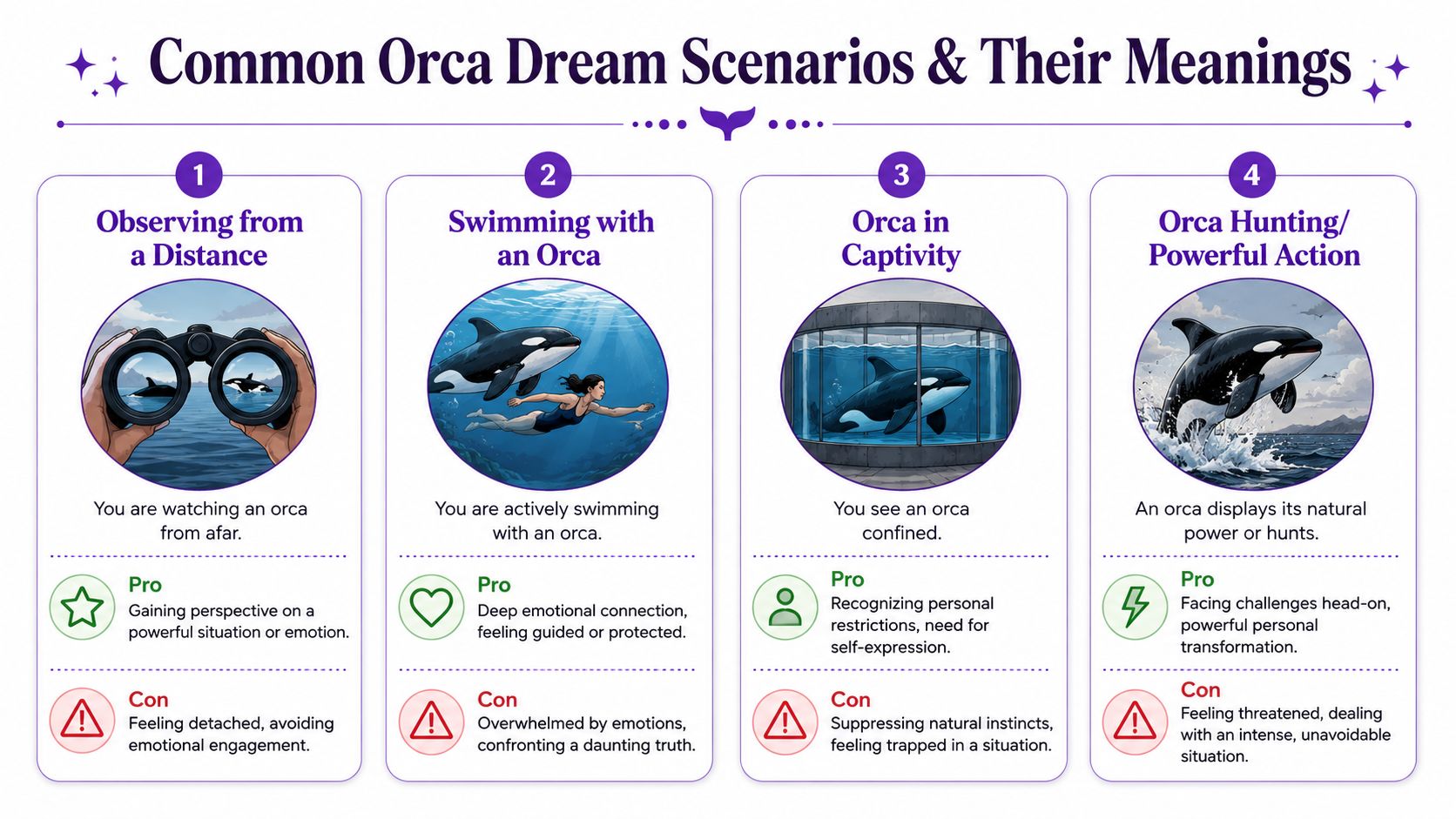
Behavior changes everything. A swimming orca, a chasing orca, and a captive orca can all carry different emotional meanings, even though the same animal appears in each scene. That's why dream context matters more than a fixed symbol, especially when the dream reflects a search for connection, threat sensitivity, or control tension (Wisdom of the Spirit on killer whale dreams).

Dream scenario Likely emotional tone What it can point to
Swimming peacefully with orcas Awe, trust, calm Comfort with your own power, emotional alignment, or ease with a group
Being chased by an orca Fear, urgency, pressure Avoidance, stress, or a situation that feels bigger than you can handle
Seeing a pod of orcas Curiosity, wonder, belonging Family themes, social support, shared purpose, or collective strength
Witnessing an orca attack Shock, alarm, conflict Inner tension, external confrontation, or a struggle over control
Dreaming of a captive orca Sadness, discomfort, restraint Feeling constrained, blocked, or separated from your natural power

How to read the scene without overthinking it

If you were swimming with the orcas and felt peaceful, the dream may be showing harmony with strength rather than fear of it. If you were being chased, the energy shifts toward avoidance, and the dream may mirror something you're reluctant to face while awake.

A pod usually matters differently from a lone animal. Pods often feel like belonging, while a solitary orca can feel like a concentrated force, especially if it's circling, watching, or closing distance. That difference is why recurring orca dreams can be a useful marker for unresolved stress, particularly when the same emotional tone keeps repeating.

Practical rule: the more the dream scene repeats, the more likely your mind is highlighting a waking pattern, not just generating random imagery.

For readers who want to compare orca scenes with broader water symbolism, Dreamscape's guide to dreaming of water can add another layer, since the ocean often intensifies the emotional message of the animal itself.

Cultural Lenses on Orca Symbolism

Orcas mean more in dreams than many other sea animals because they're widely visible in culture, yet rarely encountered in daily life. Recent consensus estimates place the worldwide wild population at a minimum of 50,000 individuals, while captive-orca records reported about 55 animals worldwide as of 24 March 2024, including 33 captive-born (Orca overview). That gap helps explain why individuals often meet orcas through films, documentaries, aquariums, and conservation stories, not firsthand encounters.

That cultural distance matters. The animal becomes a symbol shaped by media, public debate, and collective feeling, not by ordinary backyard experience. In one context, the orca is celebrated as intelligent, socially complex, and family-oriented. In another, it's framed through captivity, control, and ethical conflict, which gives the symbol an unusually layered emotional charge.

Why your dream may carry collective memory

Dreams don't only use personal memory, they also borrow from the wider emotional climate around a symbol. Orcas have appeared in public conversations about marine life, entertainment, and conservation for decades, so they often arrive in dreams with a built-in sense of importance. Even if you've never seen one in person, you've probably seen enough images and stories for your mind to treat the animal as something larger than life.

That's why an orca can feel noble in one dream and unsettling in another. The symbol already holds both admiration and controversy in the collective imagination. Your dream may be picking up one side of that tension, or trying to reconcile both.

What culture can't tell you

Cultural meaning helps, but it can't replace your own emotional response. Two people can dream of the same orca and take away completely different messages because their inner weather is different. One person may feel called toward courage. Another may be facing pressure they can't yet name.

The dream becomes clearer when you hold both layers together, the collective symbolism and the private feeling. That combination usually says more than any one-size-fits-all dictionary entry ever could.

A Practical Guide to Dream Journaling and Reflection

The fastest way to understand dreams about orcas is to capture them before daylight blurs the edges. Write the scene, the emotion, the movement of the water, and the feeling in your body when you woke up. If the image was vivid, even a few phrases can preserve enough texture for later interpretation.

A focused journal entry helps you avoid turning the dream into a generic symbol hunt. You're not just asking what an orca means in general, you're asking what this orca was doing in your emotional world. That difference changes everything.

Prompts that go deeper than “What did it mean?”

Use questions that point toward feeling and waking-life parallels.

  • What was I feeling most strongly, awe, fear, calm, or something mixed?
  • What power in my life am I embracing or avoiding?
  • Where do I feel the strongest sense of tribe or belonging?
  • What in my life currently feels vast, intelligent, or hard to control?
  • Did the orca move toward me, away from me, or beside me?

Those prompts work because they move the dream from symbol to relationship. They help you notice whether the orca felt like a guide, a threat, or a mirror. If you want to get better at capturing your notes clearly, learn how to enhance your notes and keep the language specific, not poetic for poetry's sake.

Helpful habit: write the emotion first, then the image, then the waking-life association. That order keeps you from forcing the dream into a theory too early.

Why a digital journal can help

A good dream journal makes recurring patterns easier to spot. If orcas keep showing up alongside water, distance, pursuit, or family scenes, the pattern itself becomes part of the message. Digital tools can also make it easier to compare one dream with another without losing the original wording.

For people who like visual thinking, turning a dream into an image can deepen recall. The act of drawing or generating the scene often brings out details that felt vague on waking, and those details can shift your interpretation in surprising ways. Dreams work like the sea, the more you return to them, the more structure you start to see.

Example Dream Analysis Bringing It All Together

A young woman sits with two very different dream notes. One says, “I was swimming beside a pod of orcas under a calm moon, and I felt peaceful.” The other says, “I was on a small boat, and a lone orca kept circling me.” The symbols are similar, but the emotional weather is completely different.

A young woman thoughtfully sketching illustrations of orcas in her notebook surrounded by whimsical marine-themed doodle art.

The first dream carries the feeling of being held by the sea rather than tested by it. The pod matters as much as the animal, because shared movement, calm water, and peace suggest alignment with strength and belonging. A dream like this can reflect a time when support feels present, or when the dreamer is learning to trust depth without struggling against it.

The second dream has a very different current. A lone orca changes the emotional tone at once, and the circling motion creates pressure, while the small boat adds vulnerability. That scene can point to a waking situation that feels too close, too large, or too demanding to ignore. It may also show threat sensitivity, a struggle over control, or a fear that something emotionally powerful is closing in.

The difference is not the species. It is the relationship between the dreamer and the animal. One dream feels like a blessing rising from deep water, the other like a warning buoy on a rough tide.

After she writes both dreams down, another pattern becomes clear. The peaceful dream came after a week of saying yes to support from others. The circling dream appeared during a period of pressure she had been postponing. That contrast is why the fear vs. awe lens matters so much, because it brings the dream back to lived experience instead of leaving it as a detached symbol.

Orcas are especially useful symbols for this kind of reading because they sit at the meeting point of power, coordination, and emotional depth. That makes them a strong mirror for questions about leadership, protection, and belonging, especially when the dream refuses to stay simple.

Heeding the Call of the Deep

An orca dream can feel like the ocean itself asking for attention. Sometimes it invites you into your own strength. Sometimes it brings you face to face with fear, grief, or pressure that needs a name. Either way, the dream is often less about predicting the future and more about revealing what's moving under the surface right now.

Treat the dream as information, not a verdict. If it's vivid, recurring, or connected to trauma, nightmares, or intense distress, talking with a therapist or counselor can help you sort the emotional current with more support. You don't have to decode the whole sea alone.


A CTA for Dreamscape. If you want a simple way to record, reflect on, and revisit dreams about orcas, Dreamscape can help you keep the details before they fade and turn them into a clearer pattern over time.

Why Do I Have Recurring Nightmares: Causes & Relief

You wake up with your heart pounding, the same image still hanging in the dark. Maybe it's the same hallway, the same chase, the same feeling that something terrible is just out of reach. By morning, the dream has faded, but the dread hasn't, and you're left asking the same question again and again, why do I have recurring nightmares?

Recurring nightmares can feel personal and isolating, but they're a common human experience, not proof that something is wrong with you. Sleep clinicians estimate that up to 85% of adults have at least one nightmare in a year, and 2% to 6% report them weekly, while nightmare disorder is estimated at about 2% to 5% of adults in the general population, with one clinical review putting it at about 5% (Journal of Clinical Sleep Medicine). That means the question usually isn't whether nightmares happen, it's why they keep repeating and what your mind and body may be trying to say.

Table of Contents

Your Nightmares Are Not Random They Are a Signal

You jolt awake from the same dream for the third time this week. The setting changes a little, but the feeling doesn't. There's fear, urgency, and that strange leftover sense that your brain is trying to finish a conversation your waking mind never had.

That pattern matters. Sleep clinicians describe a disposition-stress model, which means recurring nightmares often become more visible when stress, trauma, or sleep disruption is present (Journal of Clinical Sleep Medicine). In plain language, the dream isn't always the problem by itself, it's often the loudest signal in a system that's already strained.

What recurrence usually means

A one-off nightmare can be a rough night. A repeated nightmare is different. Recurrence suggests your brain has found a theme it keeps returning to, often because the emotional charge around it hasn't fully settled.

Practical rule: if the dream keeps coming back, treat it like a message from a stressed system, not a random horror scene.

That shift in perspective can be a relief. You don't need to decode every symbol perfectly to start making sense of the pattern. If the dream leaves you fearful of sleep, drained the next day, or stuck thinking about it, the dream deserves attention as a real health signal.

Some people first notice the pattern when they start avoiding bedtime. Others notice it because the same dream changes costumes, but the threat feeling is identical. Either way, recurrence often points to unfinished emotional processing, not weakness, and not a broken mind.

The Science Behind Why Your Brain Plays a Horror Movie

A diagram explaining why brains have nightmares through emotional overload, memory consolidation, and sleep cycles.

Think of your brain at night like a librarian sorting a messy pile of emotional files. Most of the time, it files experiences away normally. But when fear is intense, the filing system can jam, and the same unsettling file gets pulled back out again during sleep.

Hyperarousal keeps the alarm switched on

A 2019 review in PMC/NIH explains that chronic nightmares often come from a mix of increased hyperarousal and difficulty deactivating fear responses (PMC review). That's a technical way of saying the brain's alarm system stays too alert, even when the body is supposed to be resting.

Understanding this shifts the perspective from “I'm just having bad dreams” to “my threat-processing circuits may be stuck in high gear.” When the nervous system is already primed for danger, sleep can become the place where that unfinished arousal shows up as vivid, frightening dream material.

REM sleep can replay unfinished emotional material

During REM sleep, the brain works on emotional memory. When that process goes smoothly, experiences get integrated and softened. When it doesn't, distressing material can resurface in repeated dream loops, almost like a file that never got properly stored.

That's why recurring nightmares can feel so stubborn. They're not always trying to hurt you. In a clumsy way, they may be trying to process something that still feels unresolved.

The most useful takeaway is simple. Recurring nightmares are often less about dream symbolism and more about how fear, memory, and arousal interact during sleep. Once you understand that, the dream becomes less mysterious and more workable.

Unpacking Psychological Triggers Like Stress and Trauma

A conceptual sketch illustrating mental struggle with internal conflict, trauma, anxiety, and a sense of trapped memories.

A nightmare often borrows its script from waking life. A brutal work conflict can turn into being chased through a maze. A past betrayal can show up as a locked door, a broken phone, or a repeated failure to escape. The mind doesn't always speak in plain language, it uses scenes.

Stress and trauma can write the dream script

Population research has long linked nightmare frequency with trauma and major life stressors. In one large Finnish study spanning 1972 to 2007, people with war experience reported more nightmares along with more insomnia, depression, and anxiety, and in the combined sample of 69,813 participants, 3.5% of men and 4.8% of women reported frequent nightmares in the past 30 days, while 36.2% of men and 43.5% of women reported occasional nightmares (PMC study). In a PTSD-focused study from the same source, 56% of participants reported recurring nightmares, averaging 4.2 nightmare nights per week over 2.48 years (PMC study).

Those numbers don't mean every nightmare is trauma-related. They do show why clinicians take the connection seriously.

A useful way to think about it is this, daytime stress often supplies the emotional fuel, and nighttime dreams supply the imagery. A person under pressure may dream about being trapped, unprepared, exposed, or unable to speak. Someone with unresolved trauma may relive the emotional logic of the event even when the details change.

If a nightmare theme keeps circling around danger, pursuit, shame, or helplessness, that's often a clue worth exploring with care. A trauma-informed therapist can help with that process, and if you're in Pennsylvania, choosing a PTSD therapist in PA can be a practical starting point for finding support that fits your situation.

For a deeper look at one common dream theme, you may also want to connect recurring chase dreams with the feeling of pressure and avoidance in being chased in dreams.

When Your Body Is Sending the Signal Not Your Mind

An infographic titled Physical Causes of Nightmares listing five common biological factors that trigger bad dreams.

Not every recurring nightmare comes from a psychological wound. Sometimes the body is the louder source. Medications, alcohol withdrawal, sleep fragmentation, and other physical factors can all push dreams into more vivid, disturbing territory.

Medical and sleep causes are easy to miss

Mayo Clinic notes that nightmare disorder is diagnosed only when the dreams are frequent and cause daytime impairment, and it often co-occurs with sleep problems like insomnia or sleep apnea (Mayo Clinic). That matters because a nightmare can be a symptom of fragmented sleep or another treatable sleep issue, not just an emotional problem.

This is one reason recurring nightmares can be frustrating to self-diagnose. If your sleep is repeatedly interrupted, the brain gets pulled into lighter, more unstable sleep states, and dreams can feel more intense or memorable. A person might blame stress for months when the underlying trigger is a sleep disorder, a medication change, or a substance effect.

Your body doesn't always announce the cause clearly. A new prescription, alcohol changes, poor sleep quality, or chronic sleep disruption can all show up first as disturbing dreams.

The same is true for sleep paralysis and other sleep-adjacent experiences that can make nights feel haunted when the underlying issue is physiological fragmentation. If that sounds familiar, it may help to read about the overlap with the sensation of feeling stuck in sleep paralysis.

This doesn't mean every body-linked nightmare has a dramatic medical cause. It does mean the smart next step is to ask, “What changed recently?” A medication, a new bedtime routine, alcohol use, poor sleep, or a shift in health can all help explain why the dreams started repeating.

How to Identify Your Personal Nightmare Patterns

The fastest way to understand your own pattern is to start recording it before it evaporates. Dreams fade quickly, and the emotional tone often disappears before the storyline does. A simple journal can turn a vague fear into usable information.

What to write down right after waking

Start with the basics, then go one layer deeper.

  • Plot fragments: Note the setting, people, objects, and anything that repeats.
  • Main emotion: Write the strongest feeling, such as panic, shame, grief, or helplessness.
  • Body response: Record whether you woke sweating, tense, frozen, or breathless.
  • Daytime link: Jot down any stress, conflict, media, medication change, or major conversation from the previous day.
  • Recurring symbols: Mark the images that keep returning, even if the rest of the dream changes.

That list works because patterns usually hide in repetition, not in one dramatic detail. You're looking for emotional fingerprints.

Helpful habit: don't try to interpret the whole dream on the first pass. First, collect it.

A dream journaling app can make that easier because it lowers the friction of capture. A tool like Dreamscape can help you log the dream quickly and then sort recurring themes over time, which is useful when the same emotional pattern keeps resurfacing in different forms.

After a few entries, look for connections. Do the nightmares intensify after conflict, poor sleep, or heavy stress? Do they cluster around certain emotions rather than specific events? Those clues tell you much more than a one-time interpretation.

A short video can also help you reflect on themes without forcing a single “meaning” onto the dream:

Evidence-Based Strategies to Reclaim Your Sleep

Nightmares respond best to tools that work with the brain, not against it. The goal isn't to fight the dream or force it away. The goal is to lower the alarm level that keeps the dream returning.

Rescript the dream while you're awake

Imagery Rehearsal Therapy (IRT) is one of the most practical nightmare tools because it changes the nightmare's ending during waking hours. You write the dream down, then you revise it into a safer or more positive version, and rehearse that new version repeatedly. The point is not to pretend the original fear never happened, it's to give the brain a different ending to practice.

That works well with the science described earlier. If the dream system is stuck on threat, IRT gives it a new pathway.

Use calmer sleep thinking, not bedtime negotiations

Cognitive Behavioral Therapy tools for sleep anxiety can help when the fear of dreaming becomes part of the problem. Some people dread sleep so much that the dread itself keeps the body alert, which then makes the dreams more intense. Gentle thought work, along with consistent sleep habits, can reduce that cycle.

Mindfulness and relaxation methods are useful for the same reason. They don't erase trauma or stress, but they can lower the hyperarousal that fuels repeated nightmares. Slow breathing, body scans, and quiet wind-down routines can help the nervous system feel less cornered.

Track triggers, especially if medicine or alcohol changed

PsychCentral notes that nightmares can appear as a side effect of certain medications affecting the nervous system, or after substance use and alcohol withdrawal, and timing can make the cause easy to miss (PsychCentral). If your nightmares started after a prescription change, after stopping alcohol, or during a stressful period, that timeline is worth bringing to a clinician.

For support with pattern tracking, journaling, and reflective tools, Dreamscape support can be a practical place to organize what you're noticing.

A good rule is to treat the nightmare as information. If a tool lowers fear at night, improves sleep consistency, or helps you spot a trigger, it's doing its job. If the nightmares keep causing distress or daytime impairment, it's time to loop in a doctor or therapist who can help rule out medical and psychological causes.

Turning Nightmares into a Path for Growth

Recurring nightmares can feel alarming, but they're often meaningful. They may reflect stress, trauma, fragmented sleep, medication effects, or the brain's struggle to process fear and memory during REM sleep. Once you see them as signals, not punishments, the experience becomes less mysterious and more actionable.

That shift matters because it gives you a choice. You can look for patterns, check for sleep or medical causes, and use tools that calm the nervous system and rescript the dream. You can also ask for help when the nightmares are frequent, leave you afraid of sleep, or interfere with daytime life.

If your nightmares are happening often, leaving you exhausted, or tied to trauma, don't try to carry it alone. A sleep specialist, primary care clinician, or trauma-informed therapist can help you sort out what's driving the pattern and what will help most.


Take the next step tonight with Dreamscape, a simple way to record your dreams, spot recurring themes, and turn unsettling nights into clearer self-understanding.

Dream About Walking: What Your Subconscious Pace Reveals

You wake up with the feeling still in your body. You're walking down a road, across a field, through a hallway, or maybe through a city that doesn't quite make sense. Sometimes the walk feels steady and calm. Sometimes it feels endless. Sometimes your legs feel heavy, as if you're moving through water and can't get where you need to go.

A dream about walking often lingers because it feels so ordinary on the surface and so personal underneath. Walking is one of the simplest things we do when we're awake. In dreams, that same act often becomes a mirror for how you're moving through life. It can reflect direction, patience, uncertainty, determination, exhaustion, or the quiet hope that you're still getting somewhere.

If you've had a walking dream that felt comforting, confusing, or unsettling, your curiosity makes sense. These dreams often carry emotional truth in a very plain disguise. If your dream had the feeling of being disoriented or misplaced, themes similar to being lost in a strange city can overlap with walking symbolism and add another layer to what your mind is processing.

Table of Contents

Your Dream Journey Is Your Life Path

A woman once described a dream that stayed with her for days. She wasn't running from danger. She wasn't flying. She was walking along a long road at dusk, carrying a bag she never opened. Nothing dramatic happened, yet she woke with a strong feeling that the dream mattered. That response is common. A dream about walking can feel modest, but its message is often intimate.

Walking dreams tend to speak the language of daily life. They don't usually arrive with fireworks. They arrive with pathways, crossroads, hills, companions, weather, and pace. They ask quiet questions. Am I moving at the right speed? Do I know where I'm going? Am I carrying too much? Do I feel alone on this stretch of my life?

Why simple dreams often feel profound

Walking is the body's most basic image of progress. Step by step, you move from one place to another. In dream language, that physical movement often becomes emotional movement. A smooth walk may echo confidence or acceptance. A tiring walk may reflect a period of effort that hasn't yet brought relief.

Sometimes the most revealing dream isn't the strangest one. It's the one that feels ordinary and keeps tugging at your heart after you wake.

Many people assume dreams must be bizarre to be meaningful. Walking dreams challenge that idea. Their power comes from familiarity. Because walking is so natural, your subconscious can use it like a blank page and write your current emotional story onto it.

A gentle way to read the symbol

When you remember a walking dream, start with experience before interpretation. Notice the felt sense. Were you relieved, pressured, peaceful, late, determined, lonely, curious? That emotional tone often tells you more than the setting.

Think of the dream as a visual portrayal of your inner life. The road becomes routine. The hill becomes effort. The wrong turn becomes doubt. The destination becomes purpose. You don't need to force a mystical answer. Often, your dream is showing you how your life currently feels from the inside.

The Core Symbolism of Walking in Dreams

A walking dream often appears during seasons when life feels like a road you have to keep crossing, even if you are not fully sure where it leads. The symbol is simple, but the meaning is rarely simple. Walking usually points to how you are experiencing progress, pressure, stamina, direction, or the lack of all four.

In dream language, walking works like a quiet progress meter. It can reflect healthy momentum, but it can also mirror emotional weariness. Some people wake from these dreams feeling calm and steady. Others wake up with the same feeling as carrying groceries up a long hill. Their mind is telling the story of effort, not arrival.

An infographic titled Walking in Dreams explaining symbolic meanings like progression, emotional state, challenges, control, and exploration.

When walking reflects healthy forward motion

Many walking dreams do suggest a stable relationship with change. The movement is not dramatic, yet it feels honest. You are getting somewhere by using your own energy, one step at a time.

That kind of dream can point to:

  • A steady pace, which may reflect patience, consistency, or growing confidence
  • A clear path, which often mirrors a sense of direction or a manageable next step
  • Walking by choice, which can suggest agency and trust in your own decisions
  • Exploring on foot, which may reflect curiosity, learning, or openness to a new phase of life

Details still matter. If the dream draws attention to your feet, the ground, or the feeling of being unprotected, themes related to walking barefoot without shoes can add nuance around vulnerability, simplicity, or exposure.

When walking reflects anxiety, burnout, or depressive heaviness

Walking dreams also have a darker side, and it deserves just as much care. A long walk can symbolize persistence. It can also symbolize depletion. If the road feels endless, your legs feel heavy, or you are walking without any sense of arrival, the dream may be reflecting a life period shaped by confusion, hopelessness, or emotional exhaustion.

That is especially true when the dream feels repetitive. The body keeps moving, but nothing changes. That image often shows up when someone is functioning on the outside while feeling discouraged on the inside. The dream does not always mean failure. Sometimes it shows the painful experience of trying very hard without feeling relief.

Dream Symbol Book explores this darker reading in its discussion of walking dreams and hidden emotional warnings, linking endless or uneasy walking with fear, uncertainty, and inner strain. That perspective matters because many dreamers are not looking for motivation. They are looking for an explanation for why the dream felt so heavy.

Emotional tone changes the meaning

Two people can dream of the same road and leave with different meanings because the feeling inside the dream changes the symbol. A quiet walk through an empty street may feel peaceful to one person and painfully lonely to another.

Start there.

Ask yourself, "Did this walk feel relieving, pressured, tiring, aimless, or grounding?" The answer often gives you more useful insight than the setting alone. A dream road works like an inner weather report. Sunshine, fog, and headwind can all appear on the same path, and each one changes what the walk means.

If the dream felt spacious and steady, your mind may be reflecting trust in your direction. If it felt slow, heavy, or endless, your subconscious may be showing you a part of life that feels stuck, overextended, or emotionally flat.

Decoding Common Walking Dream Variations

Specific details sharpen interpretation. The path, the pace, your body, and the environment all change the message. A dream about walking uphill doesn't carry the same emotional texture as walking barefoot on a beach or dragging yourself through thick mud.

The easiest way to read these dreams is to match the physical sensation with a waking-life pattern. Your subconscious often turns emotional friction into bodily experience.

Common scenarios at a glance

Dream Scenario Common Emotional Context Potential Meaning
Walking uphill Effort, ambition, pressure You're working toward something meaningful, but it may feel demanding or slow
Walking through mud Frustration, delay, emotional heaviness Something in waking life feels sticky, draining, or difficult to move through
Walking barefoot Vulnerability, freedom, exposure You may feel unprotected, honest, grounded, or materially stretched, depending on the dream tone
Walking in slow motion Powerlessness, urgency, blocked action You may feel unable to act at the speed your situation seems to require
Endless walking with no arrival Anxiety, uncertainty, hopelessness Your mind may be reflecting fear that effort lacks direction or closure
Walking with someone else Comparison, support, dependence The dream may reflect partnership, pressure to keep up, or questions about shared direction

Walking uphill and walking through mud

Walking uphill usually points to effort that you can feel in your body. The dream doesn't always mean struggle in a negative sense. It can reflect a season that asks more of you. If you woke feeling strong, the hill may symbolize commitment. If you woke discouraged, the dream may be mirroring exhaustion.

Walking through mud is heavier. Mud clings. It slows. It stains. In waking life, this often resembles emotional backlog, unresolved conflict, or practical obstacles that turn every simple task into a tiring one.

Try this comparison:

  • Hill energy says, "This is hard, but I know why I'm climbing."
  • Mud energy says, "Why is everything taking so much out of me?"

Walking barefoot and walking with discomfort

Bare feet in dreams can mean openness and direct contact with reality. They can also signal exposure. Context matters. Warm sand feels different from sharp gravel. A calm barefoot walk may suggest humility, simplicity, or a return to basics. A painful one may point to feeling under-resourced or emotionally unprotected.

Shoes, roads, and the condition of your feet often reveal how equipped you feel for your current phase of life. If your dream focused on pain, awkwardness, or unsuitable footwear, your subconscious may be commenting on the gap between what life demands and what you currently have available to meet it.

Why slow motion feels so real

Some of the most distressing walking dreams involve trying to move and barely getting anywhere. There's a scientific reason this sensation can feel so convincing. Lucid dreaming research discussed in Science Insights on moving slowly in dreams reports that walking in dreams takes about 50% more time than it does in waking life. The explanation given is that REM sleep suppresses muscle movement, and the dreamer's partial awareness of that paralysis can appear in the dream as walking through water or moving in slow motion.

If that experience is familiar, themes explored in dreams of moving in slow motion may help you connect the bodily sensation with emotional pressure, hesitation, or blocked momentum.

Slow movement in dreams doesn't always mean weakness. Sometimes it means your mind is trying to represent effort under invisible restraint.

The Mind and Body Behind Your Walking Dreams

Some walking dreams feel symbolic. Others feel almost physical. You can sense your feet hitting the ground, your legs straining, your balance shifting. That realism isn't your imagination being dramatic. Your sleeping brain can activate movement-related systems in ways that make dream motion feel embodied.

Research described in Science's report on dream movements and real-life brain firing patterns found that when lucid dreamers perform a defined motor task such as walking, the sensorimotor cortex shows measurable neuronal activation. In simple terms, the brain doesn't treat dream walking like a meaningless cartoon. It recruits movement programs that resemble waking action.

Why the dream feels physical

Your body is resting, but your brain is still generating lived experience. That's one reason dream walking can feel heavy, fluid, smooth, clumsy, or vivid. The dream isn't only a story. It's also a simulation.

Psychologically, walking dreams may help the mind process direction and action. If you're trying to decide, persist, leave something behind, or keep going through uncertainty, walking offers your brain a simple form for those questions. It turns abstract emotion into movement you can feel.

Why dream walking is universal

One of the most moving findings in this area comes from people who can't physically walk in waking life. A clinical study on dreaming of locomotion in people with paralysis found that 46% of subjects with paralysis reported feeling themselves walk in dreams, and that rate was statistically comparable to healthy control groups. The study supports the idea that the neural mechanisms for dream walking are preserved regardless of physical ability.

That tells us something profound. Dream walking isn't just copied from daytime movement. It's ingrained in the brain's ability to simulate experience.

Your dream may be symbolic, but it also rests on real neural activity. Meaning and biology often travel together.

Some people like to keep that mystery visible in their environment through reflective objects or art. If you enjoy visual reminders of the dream world, this piece of artwork for inspiring interiors offers a thoughtful way to keep the theme of dreaming present without turning it into decoration alone.

From Interpretation to Insight with Dream Journaling

You wake with the feeling still in your body. Maybe you were walking toward something and never arrived. Maybe your legs felt heavy, or the road kept stretching in front of you. Before the dream turns into a theory, let it become a record.

A journal helps because dreams often speak in patterns, not single messages. One walking dream may reflect a passing mood. Several walking dreams, written down over time, can show a thread running through your days. Sometimes that thread is growth. Sometimes it is fatigue, avoidance, grief, or the lonely feeling of moving without direction.

A hand writes in an open journal with sketches of a key, door, lightbulb, and mountain.

What to write down first

Start with the raw details. Meaning can wait a few minutes.

If you have ever tried to hold onto a dream after waking, you know how quickly it slips away. Journaling works like tracing footprints before rain washes them out. The goal is not to sound profound. The goal is to catch what was there.

Use prompts like these:

  • Where were you walking. A road, forest, hallway, city street, mountain trail, beach, or somewhere impossible.
  • How did your body feel. Light, tired, strong, slow, painful, calm, unstable.
  • What was your pace. Rushed, steady, wandering, dragging, purposeful.
  • Were you alone or accompanied. Companions in dreams often change the emotional message.
  • Did you know your destination. Knowing where you're going feels different from wandering without arrival.
  • What emotion stayed with you after waking. Relief, sadness, pressure, curiosity, grief, hope.

How to notice a pattern instead of forcing a meaning

After a few entries, compare them side by side. That is often more useful than squeezing one final answer out of a single dream.

For example, you might notice that stressful weeks bring dreams of climbing uphill with sore legs. During depression or burnout, the dream may shift. The road is flat, yet every step feels difficult. In anxious periods, you may keep walking through stations, hallways, or unfamiliar streets without ever finding the right turn. Those details matter because walking in dreams does not always symbolize healthy progress. It can also mirror depletion, confusion, or the painful sense of being stuck while still trying.

Journal cue: If the path in your dream could speak, what would it say about your current life?

A short visual guide can help if you want a gentle prompt for reflection:

Questions that deepen insight

When a walking dream repeats, ask questions that stay close to lived experience:

  1. What in my life currently feels slow or heavy?
  2. Where am I pushing myself to continue without enough rest?
  3. Do I feel guided, lost, pressured, or self-directed?
  4. What destination am I trying to reach in waking life?
  5. What would easier movement look like for me right now?

These questions turn journaling into self-observation with compassion. Over time, your notes can help you tell the difference between a dream that reflects steady growth and one that indicates a need for rest, orientation, or care.

Visualize Your Inner Landscape with Dreamscape

Words catch meaning. Images catch atmosphere. If you've ever tried to describe a walking dream and felt that language flattened it, you're not alone. Some dreams carry a mood that becomes clearer when you can see it.

Dreamscape helps with that by combining dream journaling, interpretation support, and AI-generated visualizations in one place. For walking dreams, that can be especially useful because pace, terrain, distance, and emotional tone are often easier to grasp when the dream becomes visible.

Screenshot from https://usedreamscape.com

Why visualization helps

A dream about walking may sound simple in a journal entry. Then you see it rendered as a dim road under a violet sky, or a figure moving alone through an endless white corridor, and the emotional truth becomes immediate. Visualization doesn't replace reflection. It sharpens it.

That matters when your dream contains mixed signals. Maybe the path is beautiful, but you feel dread. Maybe you're surrounded by people, yet the scene feels lonely. Turning the dream into an image can reveal those contradictions more clearly.

Useful features for walking dream patterns

Dreamscape fits this kind of dream work well because it supports the full loop of reflection:

  • Record the dream quickly so details like terrain, companions, and pace don't disappear after waking.
  • Review interpretations that help you think about symbolism without reducing everything to one fixed meaning.
  • Track recurring themes so repeated walking images become easier to spot over time.
  • Generate dream artwork that gives shape to the emotional world your words only partly capture.

For people who learn through images, this can feel like switching on a light in a dim room. The dream is still yours to interpret. You just have a clearer map in your hands.

Walk with Purpose in Waking and Dreaming

A dream about walking often asks a quiet question. How are you moving through your life right now?

Sometimes the answer is encouraging. You're steady. You're committed. You're finding your pace. Sometimes the answer is harder to hear. You're tired. You're unsure. You're walking and walking without feeling arrival. Both kinds of dreams are valuable. Both tell the truth in their own way.

The most compassionate reading is usually the most accurate one. If your dream felt peaceful, let it reassure you. If it felt heavy, let it inform you without scaring you. Your subconscious isn't trying to punish you. It's trying to show you the shape of your inner world in a form you can feel.

Keep listening to the roads, hills, sidewalks, and strange paths your dreams offer you. Notice whether you're wandering, climbing, dragging, exploring, or finally walking with ease. The symbol may be simple, but the message can be life-giving. Each remembered dream is a small lantern on the path.


If you'd like a practical way to record, interpret, and visualize your dreams, Dreamscape can help you turn fleeting walking dreams into a clearer picture of your emotional world. It's a gentle companion for noticing patterns, exploring symbolism, and understanding what your subconscious pace may be trying to tell you.

Dream About Eating: Unveiling Symbolic Meanings

You wake up and still feel the dream in your body. Maybe you were biting into a peach so ripe it almost dissolved on your tongue. Maybe you were stuck at a banquet table, eating fast and never feeling full. Or maybe you were searching kitchen shelves and finding nothing.

A dream about eating can feel oddly personal because food sits at the border of body and emotion. It keeps us alive, but it also carries comfort, memory, stress, guilt, pleasure, family history, and habit. That's why these dreams can seem simple on the surface and layered underneath.

They're also common enough to deserve attention. If you've been trying to understand why they happen, what the taste and texture might mean, and whether your dream points to literal hunger or a deeper craving, you're asking the right questions. If you want a broader reference point for related symbols, this guide to dream meanings and symbols can help place food dreams in a larger pattern.

Table of Contents

Introduction to Dream Eating

A woman dreams she's standing in her childhood kitchen, eating warm bread straight from the oven. She wakes up comforted, then puzzled. A student dreams he's swallowing spicy food too quickly and wakes tense, with fragmented sleep. Another person keeps having the same dream of opening a refrigerator and finding almost nothing inside. Three different dreams. Three different messages. One shared symbol: eating.

That's why dream interpretation works best when you slow down and look at how the eating happened, not just what was eaten. In waking life, eating can mean celebration, fuel, distraction, relief, family bonding, or stress. Dream life borrows that same range.

Research supports how often food shows up in dream content. Food and eating appear in approximately 16% to 17% of recorded dream reports, which means nearly one in six dreams includes dietary imagery, according to findings published in Sleep and Hypnosis. That tells us food in dreams isn't a strange exception. It's part of the normal language of the sleeping mind.

Food in dreams often acts like a translator. It turns body signals, emotions, and daily experience into something vivid enough for you to notice.

Some dreams about eating are direct. You went to bed hungry, your body noticed, and the dream followed. Others are symbolic. The meal becomes a stand-in for love, pressure, reward, deprivation, or longing. The most useful interpretation usually comes from separating those two possibilities before you assign meaning.

Understanding Eating Dreams Core Concepts

Not every dream about eating means the same thing. A helpful starting point is to sort it into physiological hunger or psychological craving.

A diagram explaining two types of eating dreams: physiological hunger and psychological craving, with insightful summaries.

Two engines behind the dream

Think of your dreaming mind as a night kitchen with two cooks.

The first cook is the body. It notices missed meals, late-night discomfort, blood sugar shifts, and the physical state you brought into sleep. A physiological hunger dream often feels plain and direct. You're hungry in the dream. You look for food. You eat quickly. The symbolism tends to be lighter because the body is speaking in a straightforward way.

The second cook is the psyche. It uses food as metaphor. A psychological craving dream can reflect a need for comfort, pleasure, safety, attention, rest, or emotional nourishment. In these dreams, the food may matter less than the feeling around it. Are you hiding while eating? Are you never satisfied? Are you being fed by someone else? Those details point toward inner life.

A useful caution comes from a gap in current dream guidance. Some sources note that up to 30% of food dreams may stem from fasting states rather than symbolic messages, and they also point out that many guides still fail to clearly separate biological hunger from emotional craving. That concern is discussed in this overview on dreams of eating and fasting-related dream triggers.

A simple test when you wake up

When you wake from an eating dream, ask yourself these questions:

  1. Was the dream simple or dramatic?
    Plain meals often lean bodily. Charged scenes often lean emotional.

  2. What was my body like before sleep?
    Hunger, heaviness, or stomach discomfort matter.

  3. Did the dream end satisfaction or frustration?
    Satisfaction can suggest regulation. Endless eating or scarcity often suggests unresolved need.

  4. What feeling stayed with me?
    Relief, shame, urgency, comfort, and disgust each point in different directions.

Practical rule: First check the body, then interpret the symbol. You'll avoid forcing deep meaning onto a dream that may have started with a simple biological cue.

Common Symbols and Emotional Drivers

Some eating dreams feel pleasant and lush. Others feel sharp, rushed, or unsettling. The emotional driver usually sits inside the scene's tone.

A split image showing a woman happily eating sweets versus a woman feeling ill after eating meat.

When the dream feels abundant

A feast can symbolize permission, reward, appetite for life, or a wish for more emotional richness. But context changes everything. If you're enjoying the meal with ease, the dream may reflect receptivity. If you're shoveling food in with panic, abundance may signify fear of loss.

One especially revealing pattern appears in stress-related dreams. A UBC psychology summary of food and dreaming research reports that in a study of 396 participants, 17.8% said their dietary selections influenced their dreams. Among those respondents, dairy was identified as a trigger for troubling dreams by 44% and for surreal dreams by 39%. The same summary also notes that 68% of participants who dreamed of excessive eating reported high stress, while 73% of people dreaming of food scarcity reported financial worries.

Those two dream styles often confuse people. They seem opposite, but both can come from a sense of emotional imbalance. Excess can reflect overwhelm or unmet desire. Scarcity can reflect insecurity, fear, or a feeling that life isn't giving enough back. If your symbolic imagery often includes water as well as food, this comparison with dreaming of water can help you trace how nourishment and emotion overlap.

When the dream feels disturbing

Not every food dream is soft or comforting. Sometimes you're chewing endlessly. Sometimes the taste is wrong. Sometimes the food itself feels unsafe.

These details often point to inner conflict:

  • Eating sweets with pleasure can suggest comfort-seeking, reward, or a desire for ease.
  • Eating in secret may reflect shame, self-protection, or a private coping habit.
  • Choking or struggling to swallow often mirrors difficulty “taking in” a situation emotionally.
  • Raw or bloody food can carry themes of urgency, survival, aggression, or unprocessed feeling.
  • Searching for food and finding none may echo deprivation, anxiety, or fear of not being supported.

A dream doesn't diagnose you. It gives you a scene. Your job is to ask why that scene fit your inner state so well.

What Different Foods and Actions Might Signify

The strongest interpretations don't come from food names alone. They come from the combination of food, sensation, and action. Sweetness, heat, softness, crunch, urgency, disgust, and social setting all shape meaning.

Food types and dream symbolism

Research and commentary in current dream analysis note that sensory detail matters, and they also describe examples such as ripe fruit suggesting ease and raw meat suggesting survival energy. Building on that, use this table as a reflective guide rather than a fixed dictionary.

Food Symbolism
Ripe fruit Emotional ease, ripeness, pleasure that feels natural rather than forced
Bread or simple staples Basic support, routine comfort, security, home
Desserts and sweets Reward, indulgence, comfort-seeking, relief from pressure
Spicy food Agitation, intensity, stimulation, conflict, emotional heat
Raw meat Survival energy, instinct, aggression, something emotionally unprocessed
Empty plate or missing food Deprivation, disappointment, fear of not having enough

Many dreamers find this aspect challenging. Two people can dream of cake and mean different things. One cake appears at a birthday table surrounded by friends. Another is eaten alone in hiding. Same food. Different emotional story.

Why the action matters as much as the food

The verb often reveals more than the object.

  • Chewing slowly may suggest you're processing an experience carefully.
  • Swallowing too fast can point to pressure, overload, or rushing through emotion.
  • Savoring often reflects acceptance, gratitude, or readiness to receive.
  • Binge-like eating may signal compensation, emptiness, or stress.
  • Refusing food can suggest self-protection, control, or ambivalence.

There's also a practical layer. Clinical research on food-dependent dreaming and sleep quality links evening consumption of heavy, sugary, or spicy foods with more negative dream content and poorer sleep quality, and identifies sweets and dairy as leading triggers for disturbing dream themes. So if you dream about rich food in an unpleasant way, don't ignore the simplest possibility. Your body may have helped write the script.

If the eating dream also includes breaking, crumbling, or trouble in the mouth, themes from teeth falling out dreams can add another layer about vulnerability, confidence, or loss of control.

Psychological and Cultural Frameworks for Eating Dreams

Different traditions read eating dreams through different lenses. Each framework catches something useful, but none should be treated like a machine that spits out one correct answer.

Classic psychology and modern caution

A Freudian lens might see a dream about eating as wish fulfillment. You desire something, and the dream gives it shape. A Jungian lens might look for archetypal nourishment. Food becomes part of a larger story about the self needing integration, grounding, or renewal.

Those models can help, but they can also overreach if you skip the body. A person who went to bed hungry doesn't need a grand theory first. They need a grounded reading. That's why the hunger-versus-craving distinction matters so much.

Another useful modern insight comes from the role of sensory detail. Current commentary argues that many dream guides still stay too broad and fail to map taste, texture, temperature, chewing, and swallowing to specific emotional patterns. That gap is highlighted in this discussion of sensory symbolism in food dreams. In practice, this means your dream's texture may matter as much as its plot.

Culture changes the flavor of meaning

Food symbols are never fully universal because culture teaches us what food means.

A bowl of rice may feel sacred, ordinary, comforting, or communal depending on the dreamer's background. Bread may suggest family dinner for one person and religious meaning for another. Meat may symbolize strength for one dreamer and moral conflict for another. Even sweetness can split. In one life, it signals celebration. In another, it signals excess or loss of control.

Use culture as context, not decoration. Ask:

  • What did this food mean in my home growing up?
  • Was it rare, daily, forbidden, healing, festive, or stressful?
  • Who usually prepared it?
  • Did the dream copy a real memory or reshape one?

A strong interpretation joins three things at once: body state, personal history, and cultural meaning. Miss one, and the reading gets thinner.

Guided Journaling Prompts for Dream Reflection

The best part of an eating dream fades within minutes of waking. Not the basic fact that food appeared. The useful part. The temperature, pressure, flavor, disgust, urgency, company, and after-feeling.

A list of four guided journaling prompts for reflecting on dreams about eating food.

What to write down first

Start with sensory facts before you start interpreting. That keeps you from forcing the dream into a story too quickly.

Write down:

  • The food itself. Name it as specifically as you can.
  • The texture. Soft, sticky, dry, crunchy, slippery, raw.
  • The taste. Sweet, bitter, bland, spicy, sour, metallic.
  • The action. Biting, chewing, swallowing, choking, hiding, sharing.
  • The social scene. Alone, watched, welcomed, rushed, excluded.

Research commentary suggests that taste and texture are critical for emotional pattern detection, while many guides still overlook those details in interpretation. That's the core idea discussed in this article on sensory details and emotional patterns in dreams.

Prompts that reveal patterns

Use these prompts when the same kind of dream keeps returning:

  1. What need did the dream meal seem to answer?
    Hunger, comfort, escape, belonging, stimulation, or relief?

  2. How did my body feel before bed?
    Empty, overfull, restless, tense, calm?

  3. What emotion dominated the eating scene?
    Pleasure, guilt, urgency, shame, grief, confusion?

  4. What happened immediately after eating?
    Satisfaction often means something different from dread or continued searching.

  5. Does this food connect to a real memory?
    Childhood kitchens, holidays, illness, dieting, family rules, or breakups can all leave traces.

Try journaling in two columns. Put raw details on the left and possible meanings on the right. That simple separation helps you stay honest.

If you want to deepen this habit, gratitude journaling can help steady your emotional baseline and improve reflection quality. This guide on how to reshape your brain with gratitude pairs well with dream journaling because it trains attention toward patterns, feelings, and recurring themes.

Conclusion and Practical Next Steps

A dream about eating isn't just about food. It can be about the body asking for care, the mind rehearsing stress, or the heart naming a hunger you haven't put into words yet. The most helpful interpretations start small. Notice the food, the taste, the texture, the pace, and the feeling that lingers after waking.

Keep your next step simple:

  • Leave a notebook by your bed so details don't disappear.
  • Record the dream before checking your phone. Memory fades fast.
  • Note your pre-sleep state such as hunger, heaviness, tension, or emotional overload.
  • Watch for repeats. One dream can be interesting. A pattern is more revealing.

You don't need to solve every symbol in one morning. Treat the dream like a conversation, not a puzzle to conquer. Over time, your own patterns become easier to recognize. The sweet fruit, the empty pantry, the hurried swallowing, the impossible feast. They start to tell the truth in a language you can hear.


If you want help turning scattered dream notes into clearer patterns, Dreamscape offers a practical way to record, interpret, and visualize your dreams. It's especially useful when you want to track recurring eating dreams over time and see how symbols, emotions, and sensory details connect.

8 Lucid Dreaming Tips to Unlock Your Nighttime Mind

You're probably here because your dreams feel close. You remember flashes in the morning, you've had a few moments of realizing “this can't be real,” or you keep waking up just before a dream becomes vivid enough to control. That's the frustrating edge of lucid dreaming. It feels possible, but inconsistent.

The good news is that lucid dreaming isn't rare. A large meta-analysis found that 55% of adults have had at least one lucid dream in their lifetime, while 23% experience them monthly or more often, according to Oneironauts' summary of the Saunders meta-analysis. The gap between “I've had one” and “I can do this reliably” usually comes down to method and repetition.

Take Control of Your Dreamscape Tonight. These 8 lucid dreaming tips blend proven techniques with modern app-based tools to help you recognize, stabilize, and steer your dreams with confidence, and track your progress along the way.

Table of Contents

1. Reality Testing (Reality Checks)

Reality testing is the habit that makes lucidity more likely to happen on its own. During the day, you stop and seriously ask whether you're awake. If that question becomes a real reflex instead of a routine gesture, it can show up inside a dream.

A practical example is tying checks to something you already do often, like accessing your phone, washing your hands, or walking through a doorway. A Dreamscape user might log a few days of scattered checks, then notice that phone-based reminders create a steadier pattern. The app becomes less of a novelty and more of a cueing system.

A pencil sketch of a young man looking puzzled at his hands with abstract floating icons

Make the check conscious

Reality checks frequently fail when performed mechanically. Participants might glance at their hands, tap a wall, or read a line twice, yet they never genuinely doubt waking reality. Such superficial engagement does not translate effectively into dreams.

Try a short sequence instead:

  • Pause fully: Stop what you're doing for a few seconds instead of rushing through the check.
  • Ask a real question: “Am I dreaming right now?” works better when you mean it.
  • Inspect the environment: Look for impossible details, unstable text, or odd lighting.
  • Check your body: Hands, breath, balance, and spatial logic often feel strange in dreams.
  • Link it to dream signs: If mirrors, altered faces, or distorted reflections show up in your sleep, study examples like dreams about looking different in reflection and use that theme as a cue.

Practical rule: A reality check only works if attention is present. Habit helps, but awareness is the real trigger.

Another useful layer is review. If you journal a dream where you were running late, speaking to someone impossible, or seeing your childhood home, note whether you questioned any of it. Over time, Dreamscape can help you connect dream content with missed opportunities for lucidity. That turns reality testing from a generic tip into a personal training loop.

2. Dream Journaling, Pattern Recognition, and Personal Dream Signs

Dream journaling does two jobs at once. It improves recall, and it reveals the symbols, settings, emotions, and absurdities your mind repeats. Those repeating elements are your dream signs, and they're often more reliable than general advice.

Many lucid dreamers make real progress when they stop chasing random techniques and start working with their own material. One person discovers they repeatedly dream about a childhood kitchen. Another keeps finding themselves on impossible staircases or floating without effort. Once you know those patterns, you're not guessing anymore.

Turn entries into triggers

Write your dreams as soon as you wake up, before messages, before email, before the day crowds them out. Dreamscape helps because it reduces friction. Open the app, record the scene, tag the emotions, and move on. Consistency matters more than elegance.

A hand-drawn open journal displaying dream signs with illustrations of a house, flying person, and key.

A better journal entry usually includes a few specific details:

  • Location: Where are you, and does that place recur?
  • Characters: Who appears often, especially people from different life periods?
  • Emotion: Fear, curiosity, longing, embarrassment, and awe can repeat as strongly as symbols.
  • Impossibility: Flying, changing rooms, missing gravity, broken technology, or time distortions.
  • Theme tags: Use Dreamscape tagging to group entries and surface patterns over time.

If you want a stronger journaling habit, borrow techniques from structured note-taking. The same discipline that helps people learn active listening and Cornell method can also sharpen dream capture. Short prompts, recurring categories, and weekly review make your notes more useful.

Dreamscape's interpretation library can also help you explore recurring symbols through its dream meanings collection. Not because a symbol dictionary will hand you lucidity, but because reflection helps you notice what your dreaming mind keeps staging.

Review your journal weekly. Daily writing captures dreams. Weekly review reveals the patterns that actually trigger lucidity.

3. Mnemonic Induction of Lucid Dreams (MILD)

MILD works because it gives your mind a simple future instruction. Before sleep, you remember a recent dream, identify the moment when you should've realized it was a dream, and rehearse a better outcome. You're planting recognition ahead of time.

This method is especially useful for people who already remember dreams but rarely become lucid inside them. You're not forcing consciousness into sleep. You're strengthening prospective memory so that the next odd event rings a bell.

Build a script your sleeping mind can remember

Keep the formula short. Pick one recent dream from Dreamscape, find the absurd moment, and rewrite it mentally.

For example, if you journaled a dream where you were walking through your old school with your current coworkers, your MILD script could be: “Next time I'm in that school, I'll realize I'm dreaming.” Repeat it slowly while replaying the scene and seeing yourself become lucid.

A few details make MILD stronger:

  • Use your own dream language: Borrow the exact image or phrase from your journal.
  • Rehearse recognition: Don't just repeat the phrase. Visualize the moment of noticing.
  • Keep the mantra simple: The classic structure works because it's easy to remember.
  • Practice before sleep, not as a rushed afterthought: The final minutes matter.

This method pairs well with app-based tracking. If Dreamscape shows that certain themes recur often, those become your best MILD targets. A staircase dream, a missed-train dream, or a recurring ex-partner dream is more useful than a random fantasy scene you invent on the spot.

There's also a biological reason to treat MILD seriously. Research reviewed in the NIH-hosted overview on lucid dream induction and physiology found that established induction techniques can increase lucid dreaming frequency, and the review notes that successful induction through these approaches doesn't appear to harm sleep quality. That's important. You can train for lucidity without assuming you must wreck your rest.

4. Wake Back to Bed (WBTB) Technique

WBTB is one of the most effective lucid dreaming tips because it uses timing instead of willpower. You sleep for part of the night, wake up briefly, then return to bed when your mind is more alert but your body is still ready for REM-heavy sleep.

In practice, this feels less mystical than people expect. You set an alarm based on when you fell asleep, get up gently, stay awake for a short period, and then go back to bed with intention. The method works best when you're calm, not fully activated.

Use the awake window well

The biggest mistake is filling the wake period with the wrong kind of stimulation. Bright overhead lights, social media, email, and stressful tasks can kill the sleepy mental state you need.

A better WBTB routine looks like this:

  • Wake gently: Use a soft alarm after several hours of sleep.
  • Keep lighting low: Preserve drowsiness so sleep comes back easily.
  • Review one dream entry: Open Dreamscape in night mode and read a recent dream sign.
  • Add one technique: Pair the wake period with MILD or a few deliberate reality checks.
  • Return before you're fully awake: If you wait too long, you shift from dream practice to insomnia.

Weekend practice often works better because you don't resent the interruption. If you have an early workday, broken sleep can make the whole experiment feel like a bad trade. That's a major downside of WBTB. It's effective, but it isn't always convenient.

A Dreamscape user who tracks wake times, pre-sleep methods, and next-morning results can spot whether WBTB improves their own success or just leaves them tired. That matters more than copying someone else's ideal schedule. Lucid dreaming responds well to experimentation, but only if you record what happened.

5. Wake-Initiated Lucid Dreams (WILD) and Hypnagogic Awareness

WILD is the direct-entry route. You keep awareness as the body falls asleep and enter the dream consciously. When it works, the transition can feel smooth and unusually vivid. When it doesn't, beginners often tense up, chase sensations, or panic at the strange body states that happen near sleep onset.

That's why WILD is best treated as observation, not conquest. You're not trying to dominate the process. You're letting sleep happen while staying lightly aware.

A lot of people also confuse normal sleep-transition sensations with danger. If you experience heaviness, vibrations, or paralysis-like stillness, those can be part of the transition. If you want context for that specific fear response, Dreamscape's guide to sleep paralysis and the feeling of being stuck can help frame the experience without dramatizing it.

Treat the transition as observation, not performance

Start this after you already have some skill with reality checks or MILD. WILD demands steadiness. If you get excited the moment imagery appears, you'll usually snap back into wakefulness.

Use a light focus point. Breath is the simplest. Watch it become more automatic. As stray images, sounds, or fragments appear, notice them without jumping in too soon.

Here's a useful walkthrough for the general experience:

Don't react to every sensation. The less you grab at hypnagogic imagery, the more likely it is to organize into a dream scene.

Advanced practitioners often describe WILD as mentally quiet rather than dramatic. That fits the neuroscience. The same NIH-hosted review notes that lucid dreaming involves distinctive cross-regional brain communication, and frequent lucid dreamers show increased resting-state functional connectivity in areas linked to higher-order awareness. You don't need to think about the brain regions while falling asleep, but it helps to know that lucidity isn't random magic. It reflects a different state of awareness.

6. Meditation and Mindfulness for Dream Awareness

Meditation trains the skill lucid dreamers rely on most. Not control. Not imagination. Observation. When you sit and notice breath, body sensations, or thoughts without getting carried away, you strengthen the same metacognitive stance that helps you notice dream absurdity.

This doesn't mean you need a complicated spiritual practice. A simple daily routine is enough to change how often you catch yourself drifting, reacting, or believing whatever the mind presents. Dreams use that same vulnerability. Mindfulness gives you a better chance of spotting it.

Train the witness state

Short sessions are enough to start. Sit comfortably, set a timer, and pay attention to one anchor. Breath awareness and body scans both work well because they build stability without requiring belief or imagery.

The link to lucid dreaming becomes clear when you notice this pattern: thought appears, you get absorbed, then you wake up to the fact that you were absorbed. Dream lucidity is similar. A bizarre scene is unfolding, you're participating automatically, then awareness clicks on.

A practical routine might look like this:

  • Meditate daily: Consistency beats intensity.
  • Practice in the evening: That keeps reflective awareness closer to sleep.
  • Notice mind-wandering without judgment: The recovery is the training.
  • Log observations in Dreamscape: Mental patterns during meditation can mirror dream patterns.

Meditation also helps with a major lucid dreaming problem. Emotional overreaction. Some dreamers become lucid and wake up almost instantly because the realization is too stimulating. That issue is more than anecdotal. One source in the provided material claims that excitement-induced arousal accounts for 70% of failed lucid attempts, as discussed in this Reddit discussion reference. Because that claim comes from a weak source environment, I'd treat the exact figure cautiously, but the practical lesson still holds. If you can notice excitement without amplifying it, your dreams tend to last longer.

7. Lucid Dream Stabilization and Control Techniques

Getting lucid is only half the skill. Staying lucid is where many people struggle. The first seconds often decide the whole dream. If you react with too much excitement, start trying to fly immediately, or demand a giant scene change, the dream can collapse.

Stabilization comes first. Control comes after that. Think of lucidity as entering a moving vehicle. Grab your footing before you start steering.

Ground first, control second

The fastest way to stabilize is sensory engagement. Rub your hands together. Touch a wall. Look closely at textures. Listen for ambient sound. These actions anchor attention inside the dream instead of pulling it back toward waking thought.

A meditative person in a lotus pose surrounded by minimalist line art elements representing mindfulness and consciousness.

For emotional regulation, passive “stay calm” advice is often too vague. The more useful approach is active grounding. The provided material notes that newer sleep psychology discussions emphasize techniques like counting tactile sensations or reciting neutral facts, and frames them as more effective than passive calming for prolonging lucidity. Even without leaning too hard on the unsupported surrounding details, that distinction makes sense in practice. Give the mind a task.

Try this progression once you realize you're dreaming:

  • Acknowledge it: “I'm dreaming.”
  • Engage the senses: Touch, look, listen.
  • Lower excitement: Count what you feel under your fingers or name nearby objects.
  • Make small changes first: Open a door, turn a corner, ask for a person to appear.
  • Scale up later: Flying, teleporting, and full scene shifts work better once the dream is stable.

Stabilization cue: If lucidity feels fragile, reduce ambition and increase sensation.

Dreamscape is useful here after the fact. Log what destabilized the dream. Was it excitement, fear, over-control, or a false awakening? Patterns show up quickly when you record them. One dreamer loses lucidity whenever they try to summon a person. Another stays stable if they spend the first moments touching surfaces and looking at their hands. That's the kind of personal data that turns scattered success into repeatable skill.

8. Sleep Hygiene, Timing, and Environmental Optimization

Lucid dreaming techniques sit on top of ordinary sleep. If sleep is chaotic, fragmented, short, or overstimulated, recall drops and REM-rich opportunities become harder to use. People often search for advanced methods before fixing the conditions that make dreams memorable in the first place.

This is also where modern tools help without becoming gimmicks. Dreamscape can log recall, bedtime consistency, and pre-sleep habits so you can compare your better nights with your worse ones. The point isn't to obsess over perfect routines. It's to stop guessing.

Protect REM before chasing lucidity

A few boring habits do more for lucid dreaming than flashy hacks. Consistent sleep and a dim, quiet environment help the mind stay close enough to dreams that you can remember and work with them.

Use this as your baseline:

  • Keep your schedule regular: Irregular sleep makes recall less predictable.
  • Lower light before bed: Bright light and stimulating screens can push your mind the wrong way.
  • Reduce late-night disruption: Heavy meals, alcohol, and caffeine can interfere with sleep architecture.
  • Make the room sleep-friendly: Cool, dark, and quiet usually wins.
  • Use wind-down cues: Some people do well with audio routines or scent-based rituals, including ideas from guides on evening rituals with essential oils.

Supplement use belongs in this conversation too, because many people jump there early. The evidence is mixed and the trade-offs matter. The NIH-hosted review cited earlier reports that galantamine can increase lucid dream frequency by up to 42% compared with placebo, but that doesn't make it a casual recommendation for everyone. Separately, the provided material notes that Sleep Foundation's lucid dream overview is connected to discussion of side effects and sleep fragmentation when people combine supplements with induction methods. That's the key point. Chasing intensity can cost you sleep quality.

If you want long-term progress, build the foundation first. Stable sleep, clear recall, and repeatable timing beat shortcut hunting.

8-Point Comparison of Lucid Dreaming Techniques

Technique Implementation Complexity 🔄 Resources & Time ⚡ Expected Outcomes 📊⭐ Ideal Use Cases 💡 Key Advantages
Reality Testing (Reality Checks) Low, simple habit, requires consistency Minimal, seconds per check, ~5–10 checks/day Moderate increase in lucidity over weeks; improved metacognition Beginners building daily awareness; pair with journaling Easy to start, no equipment, cumulative effect
Dream Journaling & Personal Dream Signs Moderate, requires disciplined morning routine Low–moderate, 5–15 min each morning; notebook or app High recall improvement; creates personalized triggers after ~20 entries Users wanting data-driven triggers, creatives, researchers Produces reliable dream signs; enhances other techniques
MILD (Mnemonic Induction) Moderate, pre-sleep visualization + mantra Low, 5–10 min before sleep; best with 1–2 weeks practice High when practiced (research shows substantial increases, esp. with WBTB) Users with visualization ability; combined with WBTB and journaling Uses prospective memory; easy to personalize with journal data
WBTB (Wake Back to Bed) Moderate, requires sleep-schedule disruption Moderate, wake after 5–6 hrs, stay awake 20–30 min Very effective when combined with MILD (high induction rates) Weekend practice or flexible schedules; great for first lucid attempts Taps REM biology for strong induction; pairs well with other methods
WILD & Hypnagogic Awareness High, advanced skill, steep learning curve High, weeks–months practice; mental stability required Produces extremely vivid, controllable lucid dreams when successful Advanced practitioners, meditators, experienced lucid dreamers Direct transition to vivid lucidity and high dream control
Meditation & Mindfulness Moderate–High, daily practice habit building Moderate, 10–30 min/day; benefits accumulate over weeks Increases spontaneous lucid frequency (2–3x in meditators); better stability Users seeking long-term approach plus wellness benefits Improves meta-awareness, dream stability, and overall sleep quality
Lucid Dream Stabilization & Control Moderate, in-dream skills practiced after lucidity Low, practiced during lucid episodes; repeated application Longer, more stable lucid dreams; better task performance in-dream Those who already achieve lucidity and want to extend/control it Enables extended, goal-oriented lucid experiences; no external tools
Sleep Hygiene & Environmental Optimization Low–Moderate, lifestyle and environment changes Low–ongoing, consistent schedule, darkness, temp control Foundational: improves dream recall and REM quality; boosts other methods 50–100% Everyone, recommended foundation before advanced techniques Wide health benefits; multiplies effectiveness of all lucid techniques

Begin Your Journey to Lucid Mastery

Lucid dreaming gets romanticized because the payoff is so compelling. Flying, exploring impossible places, meeting dream characters, rehearsing creative ideas, or realizing “I'm conscious inside this” can feel extraordinary. But the path is usually ordinary. You repeat small practices until your sleeping mind starts responding.

The most reliable approach is layered. Use reality checks to build questioning. Use journaling to discover your dream signs. Use MILD to rehearse recognition. Add WBTB when you want a stronger induction window. Practice meditation so awareness feels familiar instead of forced. Once lucidity happens, stabilize first and control second. Keep your sleep solid enough that dreams remain available to you.

There's also value in keeping expectations grounded. Not every technique works equally well for every person. WBTB can be effective but annoying on work nights. WILD can produce vivid entries but frustrate people who try to force it too hard. Supplements may help some dreamers, but they also bring trade-offs. Even reality checks can become empty rituals if attention drops out. Lucid dreaming responds to practice, not to hype.
That's why tracking matters. If you only go by memory, you'll misread your own progress. You'll remember the big wins and forget the conditions that led to them. A tool like Dreamscape gives structure to the process. You can log dreams as soon as you wake, tag recurring symbols, notice emotional themes, and compare what happens after meditation, WBTB, or a more consistent bedtime. Over weeks, your practice becomes less random and more personalized.

This is especially encouraging if you've had only a few lucid dreams. A lot of people assume those moments were accidents. Usually they're clues. The recurring hallway, the impossible flight, the mirror that looks wrong, the moment the dream logic almost breaks. Those are openings. With steady practice, they become easier to recognize.

Start tonight with one or two methods, not all eight. Journal the next dream you remember. Pick one dream sign. Add a serious reality check during the day. Before sleep, rehearse the moment you'll recognize the dream next time. Small repetitions build the skill. Over time, your nights stop feeling accidental and start feeling explorable.


Dreamscape can help turn these lucid dreaming tips into a real practice instead of a loose intention. Use Dreamscape to record dreams the moment you wake up, spot recurring dream signs, track which techniques work for you, and visualize your dream world as your recall improves. If you want a companion for lucid dreaming, interpretation, and long-term self-discovery, it's a strong place to begin.

Orca Dream Meaning: A Guide to Its Deep Symbolism

You wake up with the feeling that the dream meant something.

Maybe you saw an orca moving beneath dark water, calm and enormous. Maybe it looked straight at you. Maybe it came closer than any wild creature should, and instead of fear, you felt recognition. Or maybe the dream unsettled you, especially if the orca chased you, circled you, or even spoke.

That reaction makes sense. Orca dreams rarely feel random. They tend to arrive with emotional weight. In dream work, that usually means the image is carrying more than one message at once. Power and vulnerability. Instinct and intelligence. Solitude and belonging. A warning and an invitation.

The most helpful way to approach orca dream meaning isn't to grab the first symbol list you find and force your dream into it. It's to slow down and ask what this specific orca was doing, how you felt around it, and what in your waking life currently needs more courage, honesty, or connection.

Table of Contents

The Powerful Message of an Orca in Your Dreams

A reader once described an orca dream this way: the animal didn't attack, didn't perform, didn't even rush. It materialized, huge and silent, and swam beside her as if it already knew where she was going. She woke with tears in her eyes and had no idea why.

That kind of dream often arrives when your inner life is asking for your attention in a bigger way. Not because something is wrong, but because something powerful in you is no longer content to stay hidden. Orca dreams often carry the feeling of depth. They can point toward instinct, emotional truth, leadership, family bonds, or the parts of yourself that know more than your conscious mind has admitted yet.

Sometimes the message feels uplifting. You may sense protection, guidance, or renewed strength. Other times the dream feels intense because the orca brings you close to feelings you've postponed, such as anger, grief, isolation, or the need to speak more clearly in an important relationship.

Some dreams comfort you. Orca dreams often confront and strengthen you at the same time.

If you've been trying to understand your dream by searching for one fixed answer, that's usually where confusion starts. An orca isn't a flat symbol. It's a layered one. The same dream image can point toward your personal authority, your emotional depths, your social world, or the voice you haven't used enough.

That's why details matter. Was the orca alone or with a pod? Distant or close? Calm, breaching, hunting, guiding, or speaking? Each version changes the emotional tone. The dream isn't only showing you an animal. It may be showing you how you relate to power, connection, and truth.

Understanding the Orca's Core Symbolism

Why this animal carries such strong dream energy

Orcas, scientifically known as Orcinus orca, are understood as apex predators with a highly complex, matrilineal social structure and the highest brain-to-body mass ratio among dolphins. In dream psychology, that combination is often read as a call to balance inner strength and leadership with emotional intelligence and community connection, suggesting the dreamer can meet immense challenges with both power and awareness, as described in this orca symbolism overview from Mirror Within.

An infographic titled Orca Dream Symbolism detailing four core meanings: power, community, freedom, and emotional subconscious connections.

That matters because dream symbols tend to draw their force from the nature of the animal itself. An orca sits at the meeting point of several archetypal themes at once. It's formidable, very social, intelligent, emotionally resonant, and oceanic. In dreams, that creates a symbol with unusual depth.

Here's a simple way to read that symbolism:

  • Power in motion: The orca can represent the strength you already have but may not be using fully.
  • Belonging and bonds: Because orcas live in strong social groups, they can reflect family patterns, loyalty, or your need for deeper connection.
  • Instinct with intelligence: This is not raw force alone. It suggests strategy, emotional awareness, and timing.
  • Depth of feeling: Because the orca emerges from the sea, it often points to material rising from the subconscious.

If you enjoy comparing symbols across dream imagery, this guide to lunar meaning for custom gifts is useful because moon symbolism also speaks to emotion, intuition, cycles, and the unseen. Readers often find that orca dreams and moon imagery belong to the same inner conversation.

The dual nature of the orca archetype

The orca often confuses people because it can feel noble in one dream and threatening in another. That doesn't mean the symbol changed completely. It means the dream is showing a different face of the same energy.

One face of the orca says, "You are stronger than you think." This is the version that appears when you're stepping into leadership, protecting someone vulnerable, or finally trusting your own instincts.

The other face says, "You can't keep avoiding what's powerful inside you." This version may surface when anger, grief, or emotional truth has been pushed down for too long.

Practical rule: Ask whether the dream showed power as something you were meeting, fearing, or becoming.

That single question helps many people stop overcomplicating their interpretation.

You can also think of the orca as a bridge symbol. It links intellect and instinct. It links individuality and pod life. It links the surface self you show the world and the deeper self that already knows what needs to happen next. In that way, the orca dream meaning often becomes less about prediction and more about alignment.

Interpreting Common Orca Dream Scenarios

Some orca dreams are vivid but straightforward. The emotional message sits close to the surface. Others feel dramatic, and that's where people often jump too quickly to the worst conclusion. A dream of threat doesn't automatically mean disaster. It may mean your psyche is using intensity to get your attention.

Dream interpretations associated with orcas often include this pattern: being attacked by an orca can point to long-held anger or unresolved trauma, a breaching orca is associated with celebration and emotional release, and a lone orca can reflect feelings of isolation that contrast with the animal's social nature, according to this dream analysis of orca scenarios.

An infographic titled Common Orca Dream Scenarios and Their Meanings, displaying four distinct symbolic dream interpretations.

A quick reference for the most common dreams

Dream Scenario Potential Meaning Reflection Question
Seeing an orca from a distance Awareness of a powerful emotion, truth, or opportunity that you haven't engaged directly yet What am I observing in my life without participating in fully?
Seeing a pod of orcas Social intelligence, family dynamics, shared purpose, or the need for stronger communication Where do I need support, honesty, or better coordination with others?
Seeing a lone orca Isolation, self-protection, or feeling cut off from your natural support system Where have I become emotionally separate when I actually need connection?
Being chased by an orca Avoidance of a strong feeling, conflict, or truth that keeps gaining momentum What am I trying not to feel or face?
Being attacked by an orca Pressurized anger, unresolved hurt, or a sense that inner pain is demanding attention What part of me feels unsafe, overloaded, or ignored?
Watching an orca breach Release, breakthrough, relief, or a moment of earned celebration What emotional work have I recently completed, even if I haven't honored it yet?
Swimming near an orca Intimacy with power, closeness to instinct, or entry into a deeper emotional process Am I learning to trust my deeper knowing, or am I scared of where it may lead?
Seeing multiple orcas Heightened awareness of several pressures or competing emotional forces in waking life Which part of my life feels crowded, intense, or socially charged right now?

How to read the scenario without overreacting

A frightening dream often feels literal when you first wake up. That's normal. But dream language is symbolic before it is predictive. If an orca attacks you in a dream, that doesn't mean external harm is coming. It more often suggests that something emotionally strong has reached a point where it can't stay hidden.

A breaching orca tends to feel different in the body. There is motion upward. Air. Space. A sense of emergence. When readers describe these dreams, they often say the dream felt alive rather than frightening. That difference matters.

A lone orca creates another kind of confusion. People often assume a large solitary animal must symbolize independence. Sometimes it does. But with an orca, solitude can also carry the ache of disconnection because the species is so strongly linked with pod life. If your dream had that lonely quality, it may be asking where your voice has gone quiet in relationships that matter.

Consider the difference in these examples:

  • You stand on shore and watch an orca surface once, then disappear. This can suggest a brief contact with an important truth that you haven't followed yet.
  • You are in the water while a pod circles at a distance. This may reflect social tension, group awareness, or the sense that many emotional dynamics are active at once.
  • An orca breaks the surface in a dramatic leap. This often carries the energy of release, acknowledgment, or a hard-won inner shift.

Don't ask only, "What does an orca mean?" Ask, "What was the orca doing to my attention, my body, and my feelings?"

That question keeps your interpretation grounded in lived experience rather than generic symbolism.

When an Orca Interacts Directly With You

Some dreams place the orca in the background. Others bring it right to you. That changes the meaning immediately. Direct contact usually suggests that the issue is no longer abstract. Your deeper mind is not showing you a symbol from afar. It's entering into relationship with you.

A black and white line drawing of a woman swimming underwater and gently touching a friendly orca whale.

Direct contact changes the meaning

If you swim with an orca, are guided by one, or feel it deliberately approaching you, the dream often points toward cooperation with your own deeper nature. You may be learning to trust a part of yourself that once felt too strong, too emotional, or too instinctive.

This is also where discernment matters. Direct interaction can feel comforting or overwhelming. A gentle encounter may reflect guidance, protection, or readiness for emotional depth. A tense one may show that your psyche is bringing you into contact with pressure you can no longer postpone.

For readers trying to compare this with other intense animal dreams, this guide to dreams of animals attacking can help clarify the difference between symbolic threat and awakening force.

What a talking orca may be asking of you

A dream in which an orca talks is especially significant. Dream analysis connected to this image treats it as a distinct milestone. It's often linked to suppressed emotions, but the deeper implication is a call to use intellectual intuition, meaning strategic communication guided by emotional truth, as explored in this deeper look at talking orca dreams.

That nuance gets missed a lot.

Many interpretations stop at, "You have feelings you need to express." That may be true, but a talking orca suggests something more refined. The dream may be asking not only for honesty, but for wise honesty. Not blurting. Not exploding. Not staying silent. Speaking with timing, clarity, and instinct working together.

Here's what that can look like in waking life:

  • A difficult conversation at work: You know something needs to be said, but the dream suggests choosing language that protects the relationship while still naming the truth.
  • A family dynamic that rewards silence: The orca may symbolize the part of you ready to speak from loyalty without self-erasure.
  • An emotional secret you've carried too long: The dream may be showing that voice is part of healing, especially when shame has kept you quiet.
  • A leadership moment: You may need to communicate from both authority and empathy instead of relying on one without the other.

After reflecting on the symbolism, some readers like to pause with a visual cue before journaling more extensively.

If the orca spoke actual words, write them down exactly as you remember them, even if they seem strange. If it communicated without words, note the felt message. Dreams often compress meaning into image, tone, and atmosphere. A talking orca may be your psyche's way of saying, "Use your voice, but use it with depth."

Tuning Into Your Dream's Emotional Frequency

Start with the feeling, not the symbol list

Two people can dream of the same orca and need entirely different interpretations. One wakes up feeling held. The other wakes up shaken. The symbol is the same. The emotional frequency is not.

That's why your first job is to name the feeling as precisely as you can. Not just "good" or "bad." Was it awe, dread, peace, grief, reverence, tension, loneliness, curiosity? The more exact the feeling, the more exact the interpretation becomes.

Try this short emotional check:

  • If you felt awe: The dream may be showing healthy respect for your own depth or potential.
  • If you felt fear: You may be close to a strong truth you haven't integrated yet.
  • If you felt calm connection: Your inner world may be opening to guidance and trust.
  • If you felt sadness: Themes of belonging, loss, or disconnection may be present.

A dream symbol tells you what kind of energy is present. Your emotional response tells you how that energy is landing in you.

Let the setting modify the message

The environment around the orca matters more than many people realize. Water, weather, distance, sound, and visibility all act like emotional modifiers.

Clear water often suggests access to feeling or insight. Murky water can suggest confusion, emotional overwhelm, or uncertainty about what you're sensing. Calm seas may reflect readiness. Rough water can point to stress or internal conflict. Shoreline dreams sometimes show you standing at the edge of emotional involvement, while open ocean dreams can reflect full immersion in a deeper process.

If water played a major role in your dream, this guide to dreaming of water can help you read those background signals more clearly.

A useful way to interpret your dream is to combine three things only:

  1. The orca's behavior
  2. Your emotional response
  3. The atmosphere of the dream setting

That simple triad usually gives a better answer than any long symbol list.

Journaling Prompts to Unlock Your Dream's Wisdom

Dreams become clearer when you work with them, not when you only analyze them once and move on. Orca dreams especially tend to unfold over time. The first layer may be obvious. The deeper layer often appears when you write.

Questions for power, voice, and belonging

Start with whichever prompt creates the strongest response in your body:

  • Where in my life am I being asked to hold more power responsibly?
  • What feeling have I respected least lately: anger, grief, instinct, or longing?
  • Did the orca feel like a threat, an ally, or a mirror?
  • Where do I need stronger connection with family, friends, or community?
  • What conversation am I postponing because I want the perfect words?
  • If the orca was speaking for a wiser part of me, what would it want me to admit?
  • Where have I become emotionally isolated, even if I seem functional on the outside?
  • What part of my nature feels too large, too intense, or too intelligent to keep shrinking?

If your dream included direct contact, add one more question: What changed in me the moment the orca noticed me back?

Write the answer quickly first. Then write a second answer that feels less polished and more honest.

That second answer is often where the true dream work begins.

A simple dream work practice

You don't need a complex ritual. Sit calmly, close your eyes, and return to the dream image for a few minutes while awake. See the water. See the orca. Let the scene replay without forcing it.

Then ask one question inwardly: What are you showing me now?

Write whatever comes, even if it arrives as fragments. A memory. A sentence. A body sensation. An urge to call someone. Dream work is less about decoding a puzzle and more about building relationship with your inner life.

If the same orca image returns in later dreams, compare the emotional tone each time. Repetition usually means the psyche is staying with a lesson that matters.

Record and Visualize Your Dreams with Dreamscape

If you've ever had an orca dream fade within minutes of waking, you already know the challenge. The details that matter most often disappear first. The angle of the water. The feeling in your chest. The exact words the animal seemed to say.

That's where a dedicated tool helps. Dreamscape gives you one place to record dreams as soon as you wake, organize recurring symbols, and revisit emotional patterns over time. For a symbol as layered as the orca, that matters. You're often not looking for a single fixed meaning. You're tracking how the same image evolves across different periods of your life.

Screenshot from https://usedreamscape.com

The app also helps turn dream imagery into visual art, which can be surprisingly useful with ocean dreams. An orca rising from dark water, circling a boat, or speaking face-to-face often carries emotional meaning that becomes clearer when you can see it again instead of trying to hold it only in memory.

If journaling is already part of your spiritual or reflective life, this piece on HolyJot's prayer journaling advice pairs well with dream tracking. It offers thoughtful prompts that can deepen the habit of listening inwardly rather than rushing past what moved you.

A good dream practice is simple: record quickly, reflect thoughtfully, return later. Over time, patterns emerge. And when a symbol as powerful as the orca keeps visiting, those patterns can become a map.


If you want a simple way to capture, interpret, and visualize powerful dreams like these, Dreamscape can help you turn fleeting night images into an ongoing self-discovery practice.